
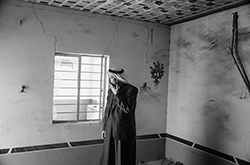
Returning from Sinjar: A Conversation with Nathaniel Brunt, 2025
Sinjar, Iraq 2023
You could describe Nathaniel Brunt as a photojournalist, media researcher, or an archivist/scholar, but another way to approach his work is through his studies of imagery and conflict. These include a 2011 B.A thesis at Toronto Metropolitan University, American Visual Media and the Vietnam War: 1965-1973, and The Blue Bench: Medicine, Photography and the First World War Facial Wound, through which he earned an M.A. at the University of Kent in Canterbury in 2012. His second M.A. thesis, #shaheed, which examined the ongoing conflict in Kashmir, was submitted to the joint TMU/York University program in Communication & Culture in 2016.
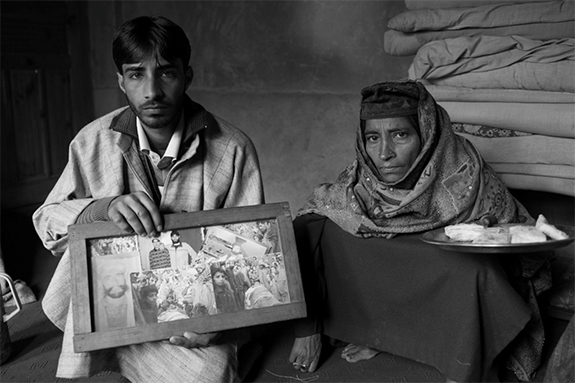
From #shaheed: A Metaphotographic Study of Kashmir’s Insurgency
In 2023, Brunt completed his Ph.D., also for the TMU/York program; his dissertation was titled Dangerous Images: Photography, History, and Kashmir’s Insurgency (1989-2008). He is now a Postdoctoral Scholar at the University of Victoria Libraries & Centre for Global Studies, where he has been appointed Principal Investigator for the Kashmir Valley Archive (in association with the UCLA Modern Endangered Archives Program) and co-leader of The Sersal Project in Iraq. We had a chance to discuss his work shortly after his return from Sinjar, Iraq, in the late spring of this year.
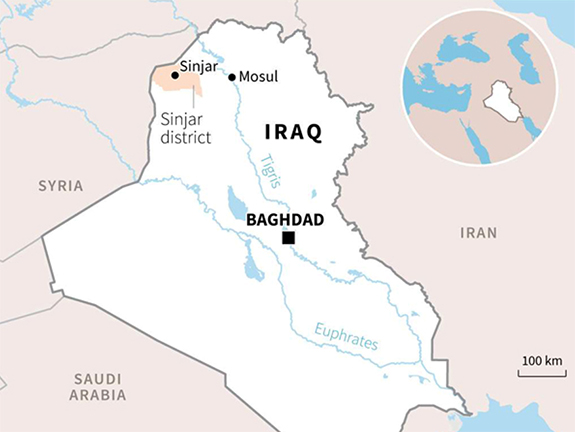
North of Baghdad and west of Mosul, adjacent to the border with Syria, the Sinjar region is one of the ancestral homes of the Yazidi people. Flat and for the most part featureless except for the low Sinjar Mountain, it is an agricultural region devastated not only by war but also by climate change: green in March, by late spring it is parched and brown, and during the summer temperatures reach into the upper 40s Celsius. Water is scarce, and often needs to be trucked in.
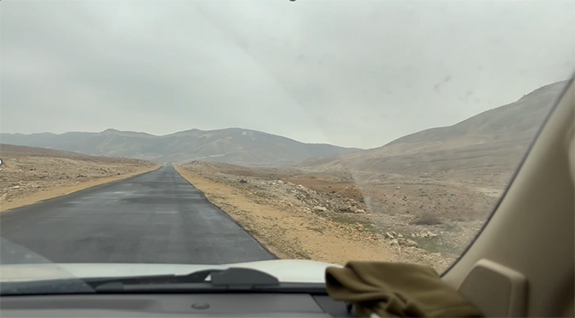
Driving towards Sinjar, 2025
When ISIS forces invaded in 2014, their aim was to eliminate the Yazidis: they systematically blew up shrines and cultural sites, randomly murdered adults, sold young women and girls into slavery, and forced some young boys and young men to fight for them. Many Yazidis died trying to hold off the invaders; others fled, driving up Sinjar Mountain until the road ran out, then climbing to higher ground however they could.
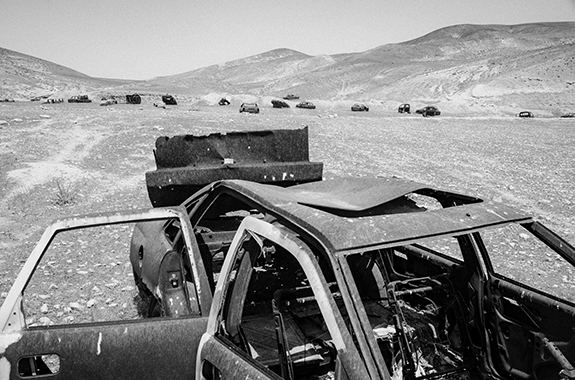
The Iraqi government pushed out ISIS in 2017, but the region is scarred and broken: destroyed structures, mass graves, landmines and IEDs can be found in some areas; mummified remains and even bones, still unburied, are still being discovered. A lot of rebuilding has yet to be done—the economy is in a state of dysfunction, and factionalism persists. Brunt reported that some Yazidis keep their car trunks always packed, ready to leave at a moment’s notice.
I’m now starting my third year as a postdoc at the University of Victoria, working with the library; my research focuses on digital archives related to the aftermath of conflict, exploring ethical and methodological implications. This ties into my fieldwork in Iraq, where I have been working on a project about the aftermath of the ISIS genocide and its effects on the remaining Yazidi population. The narrative structure is very simple: we are trying to document life before, during and after the genocide. It’s essentially a photo-based project, combining family images with archives in the west, which we are now bringing back into the community.
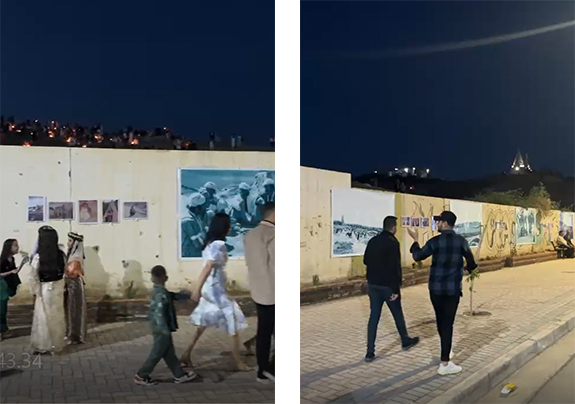
This past spring, we put on a series of exhibitions in northern Iraq, deliberately choosing to display the photographs in the regions where they had been made, rather than in galleries in North America or Europe. The shows were installed in mid-April during the Yazidi New Year celebrations, when many members of the globally scattered diaspora populations return to their former homelands.
The idea was to present the work within the communities of people still living there, as well as to an audience of those returning. We chose non-traditional, outdoor spaces in towns and villages, including Bashiqa, which had been occupied by ISIS for two years. The exhibitions were designed to be public, accessible and relevant to local audiences, and they attracted many thousands of visitors who were in town for the New Year and for visits to shrines and sacred sites.
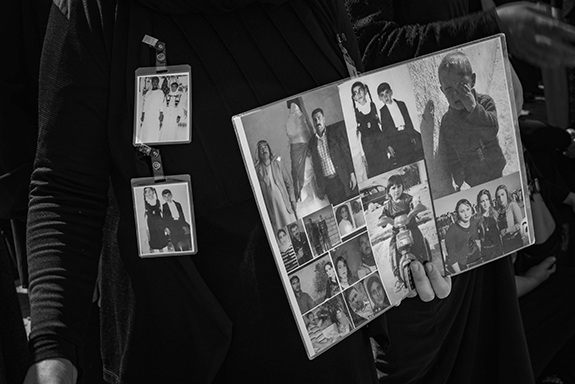
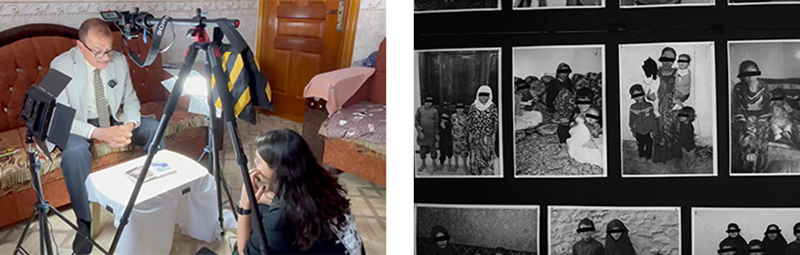
We’re still building on what has been collected so far, sometimes by doing video interviews. We film photographs and albums from directly above, while participants discuss the images under the camera, pointing out family members and sharing stories. These seemingly simple family photos can reveal significant personal and collective histories, especially when interviewees explain who has disappeared, emigrated, or survived the genocide. We’re not trying to do something overtly political, but we are using these images to talk about political history, and a kind of emotional history as well.
Also—and this is really interesting—my colleague, Marc Marin Webb from the University of Pennsylvania (whom I actually met in Iraq), had by happenstance discovered an archive of photographs at UPenn which had been made during the 1930s by a team of American archaeologists who were working in many of the extremely remote and at that time hardly-known Yazidi communities. The pictures remained essentially unseen for nearly a century, and they document life from an era when there were no cameras in the region; it was not until the 1980s that cameras found their way here. It turned out that one image we exhibited was seen by the great-grandson of the bride and groom pictured in the wedding party. He’d never seen the image, or even any pictures from that period, but he recognized his family’s home in the background.
The genocide, ironically, has brought a kind of cultural revitalization, where people are now becoming very interested in their own history. It’s been very rewarding to be able to contribute to that process. The big thing we are trying to do is get the photographs out there, and work with the community to create an archive rather than taking an extractive approach to all this material.
One result has been The Sersal Project, a joint venture between UPenn, UVic, The Goethe-Institut in Iraq, and other organizations. They have published a set of images as postcards, each of which has an embedded QR code on the address side, enabling anyone to view and download the full collection without cost or restriction.
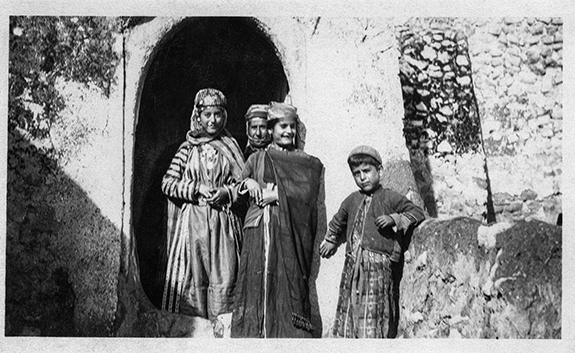
A lot of the feedback we got from the Yazidis was along the lines of “we don’t want to just see more pictures of the genocide, we don’t want to talk about that… we’ve been represented so much as the people who lived through a genocide. We want to be seen in terms beyond that frame of reference.” But this is a very unresolved issue—the tail end of these things goes on for a very long time.
And in Iraq now, you have a generation that’s been raised entirely in IDP camps. So another part of the family photo material becomes relevant when you have this schism in terms of generational understandings of culture and history: if your own history is just the camps, you don’t necessarily have a connection to the way that your parents or even your older siblings grew up.
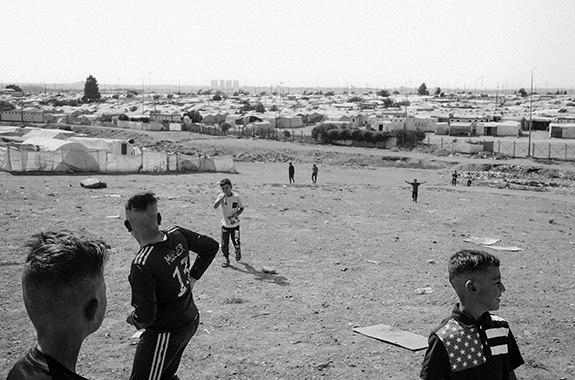
We’re very interested in, I don’t know, what do you want to call it? Vernacular heritage—not in the sense of built heritage, but in the sense of things like family photographs. Always in the aftermath of conflict or genocide, or mass violence, mass trauma, there’s a real focus initially, which is very, very important, on the collection of documents and creation of documentation for a forensic investigation, for judicial purposes—this idea of the pursuit of justice.
But also there’s an aspect of it that gets less focus, which is the need to preserve the histories of this experience in terms of everyday life, of what that was like, and what was lost in that sense. When a culture goes through something like what happened to the Yazidis, there is such importance to have access to not only justice, but to have access to a past.
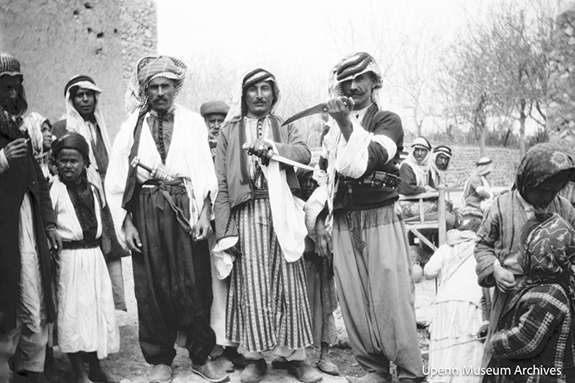
This is especially true when a party or an organization or a state tries to destroy that past—the mass violence is always one thing, but it’s often accompanied by a purposeful attempt to erase that part of the story. I’ve seen it—certainly in Kashmir, and I’ve seen it a lot with this project in Iraq.
These exhibitions just reinforce this fact: there is a ‘click’ at a certain point with people when they realize, “we get it, this is really important that we do this given what has happened.” Because often it’s difficult to realize that things like a family photograph, something that one may think is totally banal or unimportant, can have such significance moving forward. People have started to realize that they lost so much in 2014, and if they lose this aspect of the record, they lose more than just the images.
Take the example of photographs after World War II. The pictures from places like Bergen-Belsen are shocking and horrible and will always be etched into the minds of those who have seen them. But it’s very hard for people to comprehend that this can be real. But when you look at images such as Henryk Ross’s images from the Lodz Ghetto, you see what happened in a different way. You don’t always have to show all the absolute horrors… if you show things like family photographs, we can all connect to those kinds of things. I actually brought a book similar to Ross’s to Iraq, and people really responded to it.
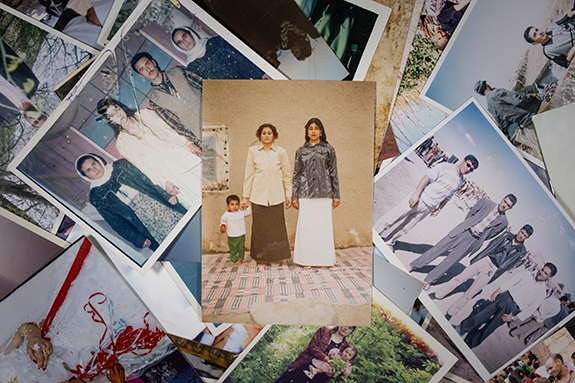
Societies also change over time; they are never static in the aftermath of invasion and trauma. And now you have a generation that’s really moved into a more international space, where they’re very much exposed to a lot of different things. Which means that the culture is also shifting—I’m not saying it’s a bad thing or a good thing, but it is a process of change.
Yezidism from a religious standpoint is endogamous, which means you can never become a Yazidi, you can never change, you have to be born into it, you have to marry a Yazidi. As soon as you break that, you’re not a Yazidi anymore. So you have this very closed nature within the community, too. This has meant that there are changes taking place with young people, where they’re becoming much more international. But simultaneously, there’s also a growing interest among those same people to look back into their past and try to preserve some of the cultural traditions that they have. We notice this a lot.
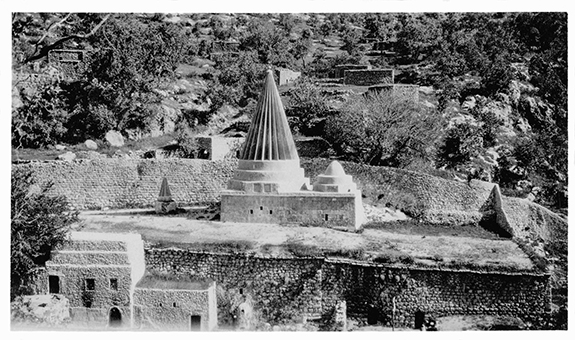
We’re documenting the exhibitions, and documenting ways to think about how these photographs might be remixed, repurposed, whatever, in the social lives of the Yazidis. There is an archival preservation aspect as well. It’s not just the original raw documents, but also the ways they’ve been reinterpreted over time.
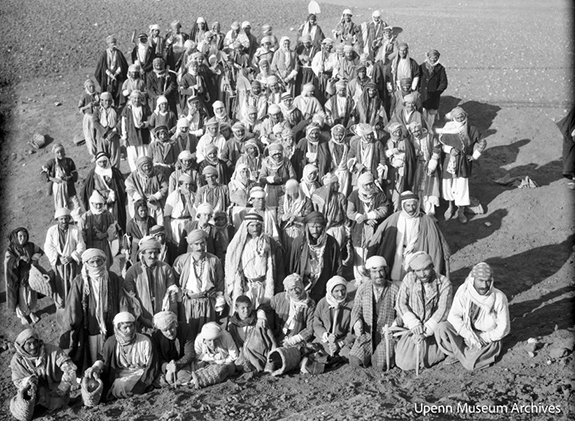
Photographic meaning isn’t static; it’s constantly evolving in different contexts. And I think this is something that’s come up a lot more in contemporary thinking from a photo theory perspective, in the writings of scholars like Elizabeth Edwards or Christopher Pinney. A colonial photograph, for example—yes, it was taken from a specific perspective, which is embedded to some capacity into the image. But that doesn’t mean that image can’t exist in ten different contexts. It’s not always a colonial image, right? And this is the thing: these photographs of an archaeological expedition taken by a Western outsider, yes, there’s a specific way of seeing them—obviously the photographer made a decision at some point to make each picture in a certain way. But it’s important to think about what photographs can do in terms of cultural preservation or revitalization. And what I’ve realized from this project is that they can do a lot, and they can be really meaningful for people.
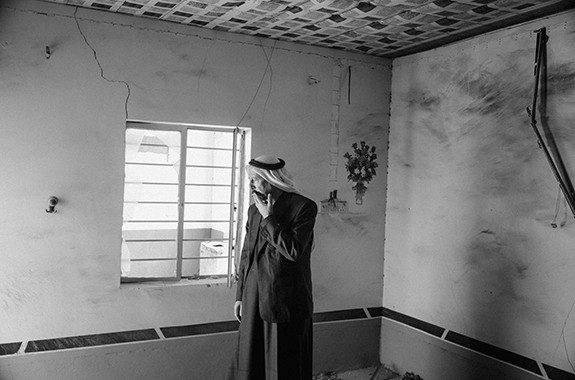
Images from The Sersal Project can be viewed here:
Upenn Images Community Share – Google Drive
A selection from postcards printed to date is available at: 250403_yazidiproject_postcard_148x105_PREVIEW.pdf – Google Drive
Following our conversations, Brunt forwarded a number of recent articles about this project:
The Forgotten Photographs of Iraq’s Yazidis – New Lines Magazine
Before the Silence: The Forgotten Photographs of the Yezidis
Preserving cultural heritage in times of war – UVic News
Forgotten Ezidi Photos From 1930s Discovered in U.S. Museum – Ezidi Times
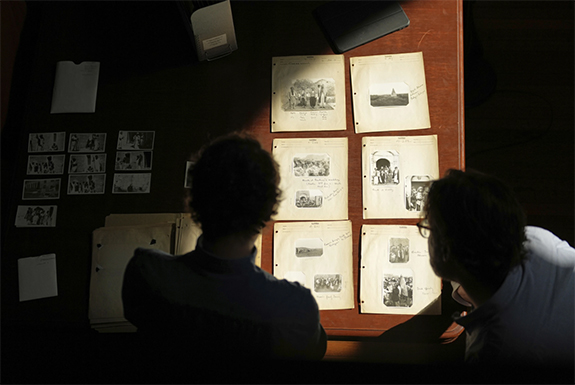
Marc Morin Webb and Nathaniel Brunt at the Penn Museum Archives, August 2025
AP Photo by Matt Rourke
All photographs courtesy of Nathaniel Brunt and The Sersal Project; all rights reserved.