
FULL CIRCLE: A Conversation with Thomas Blanchard
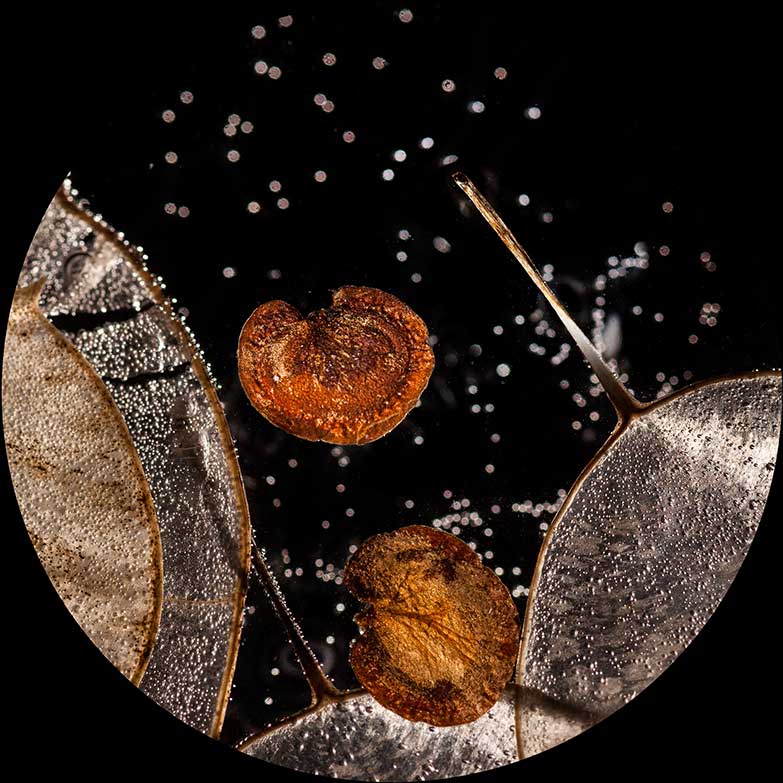
From The Vault, 2012
Born in Rochester, N.Y., Thomas Blanchard originally studied political science and geology, earning an undergraduate degree from the State University of New York at Potsdam in 1994. Following two years of travel in 1999-2000, he enrolled in the Photography Studies program at Toronto Metropolitan University, graduating in 2005 with a Bachelor of Fine Arts; his graduate studies took place at York University, where he completed an MFA in 2008.
Blanchard’s recent projects include both photographic and photo-based works, exploring issues related to food, the built environment, and the changing climate. Among these are the Chinese Market, Fish Bowl, Fabricated Foods, and Modern Homes portfolios, as well as several more complex, site-specific installations: Leona Drive, The Vault, and Thaw/beta.
On his website, Blanchard writes:
I am interested in how art can open a portal to experiences beyond straightforward cognition…. My work blurs fact with fiction and empirical evidence with fantasy, exposing and exploiting the cracks in the divide.
By combining photographic images with three-dimensional sculptural components, soundscapes, color and light effects and alterations of scale, I aim to create environments that are simultaneously imaginative and tactile, affecting the viewer’s mind and body.
In designing a space for interactive engagement, the photographic ‘still’ image is activated, and the viewer becomes integral to the generation and negotiation of meaning in the work itself.
Widely exhibited, Blanchard continues to work as a professional photographer specializing in studio and editorial portraiture. He is also active as a teacher, offering courses in photography, digital imaging and studio production at Toronto Metropolitan and York universities as well as at the Branksome Hall School. We spoke about his work in June 2026, shortly before he left for a return visit to India and Ladakh.
How did you get into the visual arts from a background in Political Science and Geology?
My dad always pushed politics and political theory with me. Starting when I was about ten, he made me read the front page of The New York Times every day. In a way it was too much… but I ended up going to school for a political science degree, which led me to thinking about ideas and about how life actually works. The minor in geology was because I loved being outdoors. I have a really strong relationship to nature, and being outdoors, that’s really my religion. I’m pretty much an atheist other than that.
I just appreciate the relationship between my body and my mind in these spaces, and that’s also why I like traditional cultures, because they’re so closely connected to the land. I studied geology because I wanted to know more about the land and how we all live on it.
From there, I taught special ed for a while, traveled in Africa, lived in Alaska for a couple of summers, and then I did the big trip, 18 months to two years of traveling all around the world, working on farms, traveling light. And when I came back I was thinking, what the hell do I do with myself? I was culture shocked, having been away for two years at the age of 30. But these experiences, particularly in places like Ladakh, are why I am going back 26 years later.
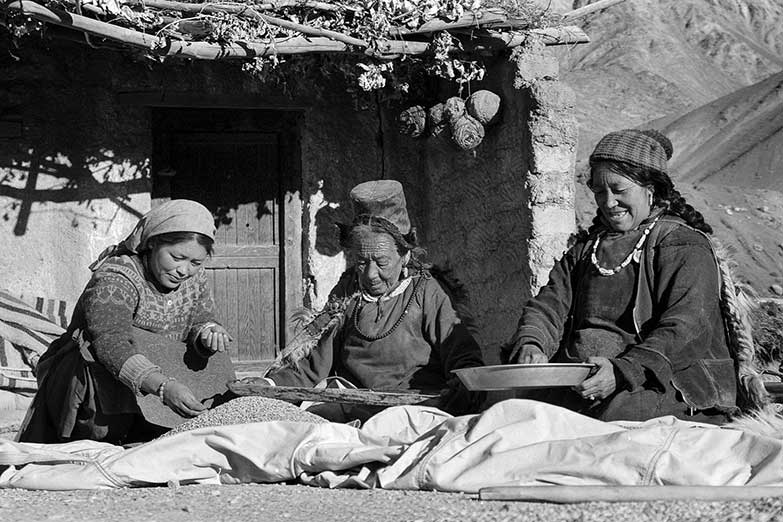
Three Generations, Ladakh, 1999
Someone asked me what I wanted to do, and even though it’s a cliché, I said I would love to be a National Geographic photographer, and of course she said, “well, just do it!” And that’s when I applied to the Image Arts program and was put on the waiting list and eventually accepted. I hadn’t thought of myself as a creative person, but somehow the ideas about political science and geology that were already in my brain worked as a kind of seed for ideas about how to express myself visually. And later, when I was in the York graduate program I was expected to teach, which I found I also loved. Now, teaching in the digital and interactive realms, I can help students see the possibilities of photographic expression outside the conventions of the medium itself… this is interesting in so many ways.
I made enough photographs during the earlier trip to Ladakh to put together my first book, which depicted a quite traditional, family-oriented agrarian society. I’m sure it will be different this time, the environment there is so fragile and there is little in the way of infrastructure. I think about things like the seed banks in Svalbard and in other places – they have one in India, and I’m told there are now repositories in Iran and even Syria — and about how much of the world is showing signs of environmental stress, and I wonder, why are we all doing this?
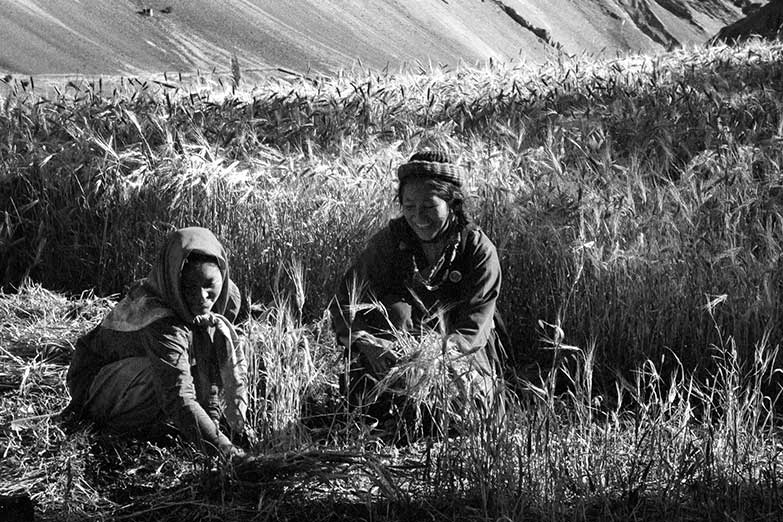
Two Women, Ladakh, 1999
This question gets me concerned about the people in Ladakh and the people who actually live in these environments, so stressed by external forces that they have to change their way of living. Just to give one example, they are now working to create artificial glaciers so they will have water for irrigation during the warm months — this is just bizarre, and this is where it really starts to affect you, thinking about the forms of life that we are trying to preserve while other aspects are being destroyed. But that’s also where making images can become both more emotional and more poetic.
Moving forward a bit: since my interest in agriculture goes so far back, it seemed logical to do some work about food while I was in the Image Arts program. I had seen the work of photographers like Michiko Kon, and read a lot of Michael Pollan’s essays, and every day riding my bicycle to TMU, I went through Chinatown. I had traveled to China, but never felt like I understood the culture, so in Toronto I started working on the Chinese Market sequence, purchasing food items there and making still life images. The market materials, plants, insects, vegetables and animal forms became a way to think about translation, cultural misunderstanding, transformation and the construction of meaning through photography.
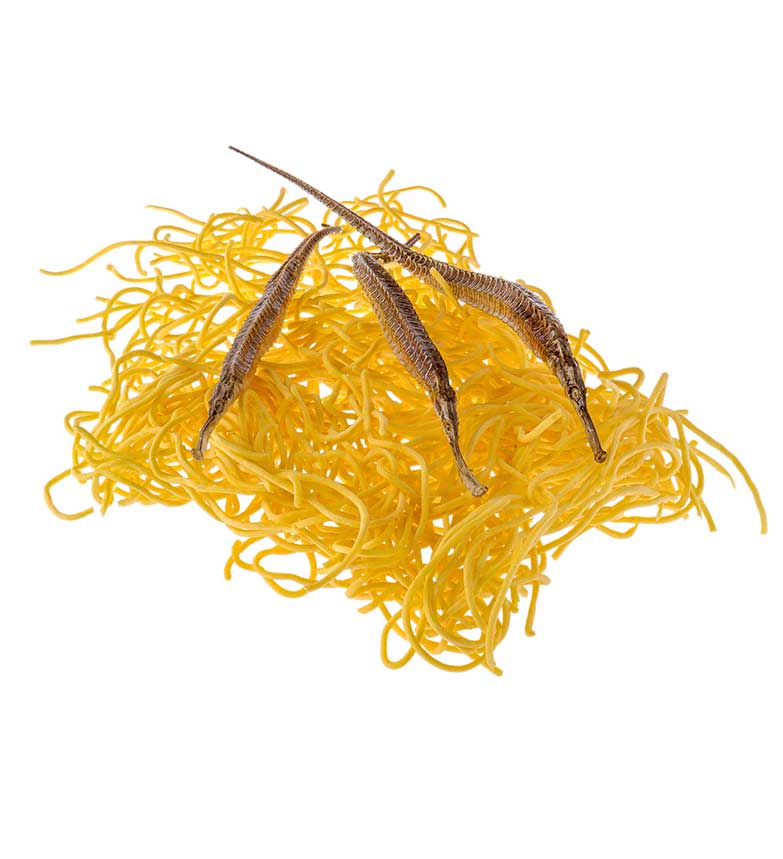
From Chinese Market, 2004
It became a really interesting challenge, and from there I moved into the Fish Bowl series, where I was treating things like seafood, eggs, or chicken parts as both subjects and specimens, along the line of some of the displays you can see in the Mütter Museum in Philadelphia, or other zoological or natural history museums.
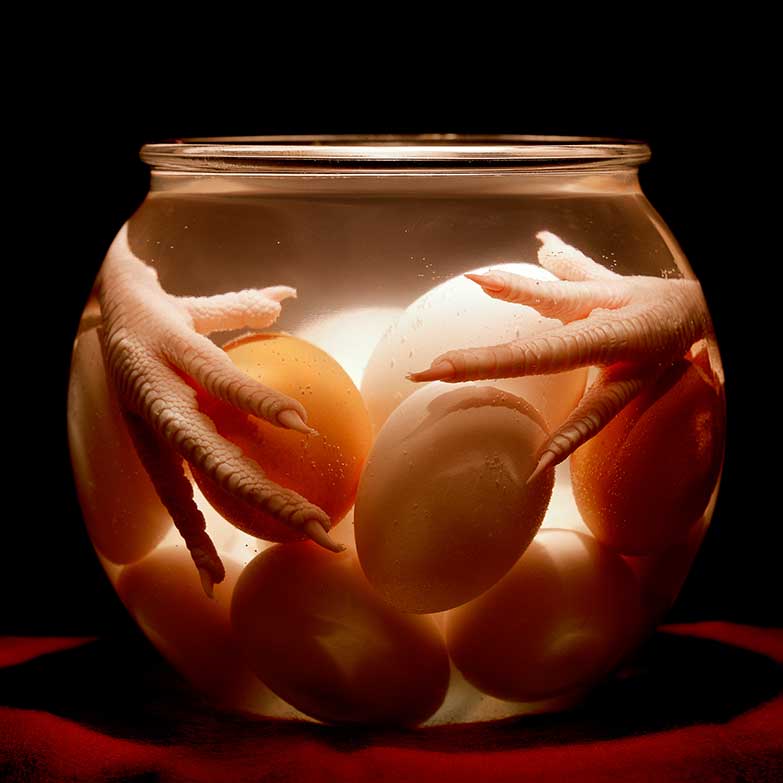
From Fish Bowl, 2004
I didn’t quite understand what the project was when I was doing it – I was learning about lighting as well as how to create convincing images – but I was invited to participate in a show outside Montreal about the politics of food, and I asked the curators what they thought, and they said, “Well, we see these as a metaphor for the containment of animals, the restraints of factory farming and our control over animals” and that really clarified things for me. I began to see that the juxtaposition of things that do not necessarily go together can create new narratives.
For example, this image from Fabricated Foods, it’s about aspartame, which is in Diet Coke. If it’s heated too much, it will turn into formaldehyde – something we use to preserve museum specimens, and also a poison. During the Iraq war, some of the Diet Coke shipped over was stored in really hot areas, so its chemistry actually changed because of the heat. I started reading all these books about the politics of food, and visualizing new images as I was reading and researching.
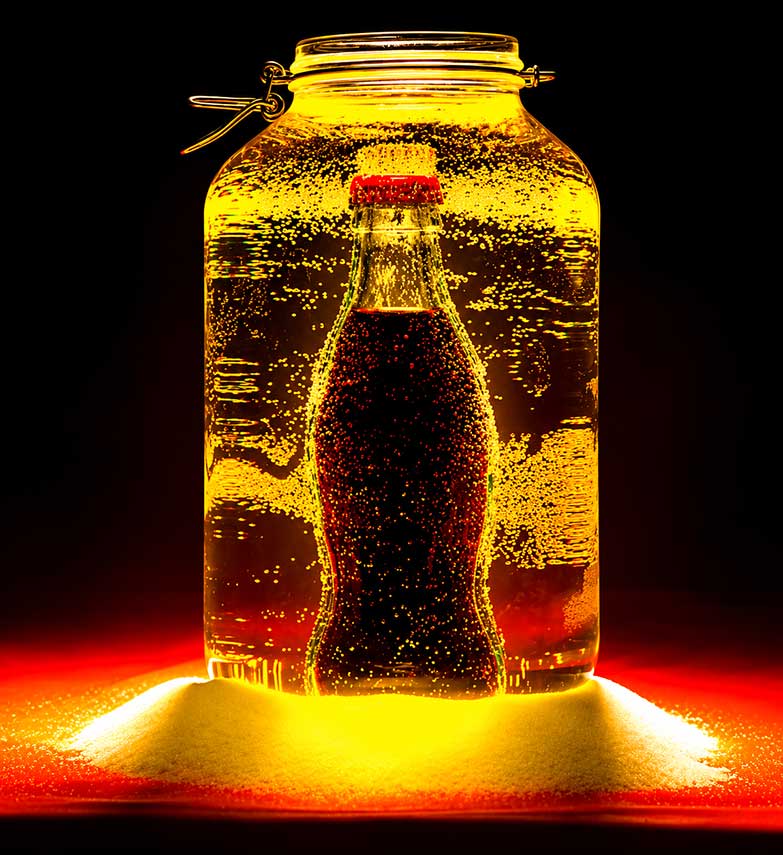
From Fabricated Foods, 2005
In the graduate program at York, I started working on Modern Homes, which explores the hidden toxicities inside contemporary housing. I wanted to create images that would have an almost bodily effect on the viewer, so that the audience would experience the images at a sensory level, not just a visual one. One day the gallery where I was showing got accidentally flooded, and I walked in and there were all these puddles on the floor, reflecting the images on the walls. The images weren’t framed, and you had to step around the puddles to move through the space, and I suddenly realized that photographic images could be extended beyond themselves, into three-dimensional space — and that I could activate that space, either with colored light, or sound, or sculpture. So this was a new opening, a new direction: I wanted to break the barrier between where the photograph ends, and where the viewer stands. The images have intrinsic meaning, but they also operate in space to create new images, new sense impressions. For one exhibition I even made fake puddles out of resin, to reflect what was on the walls.
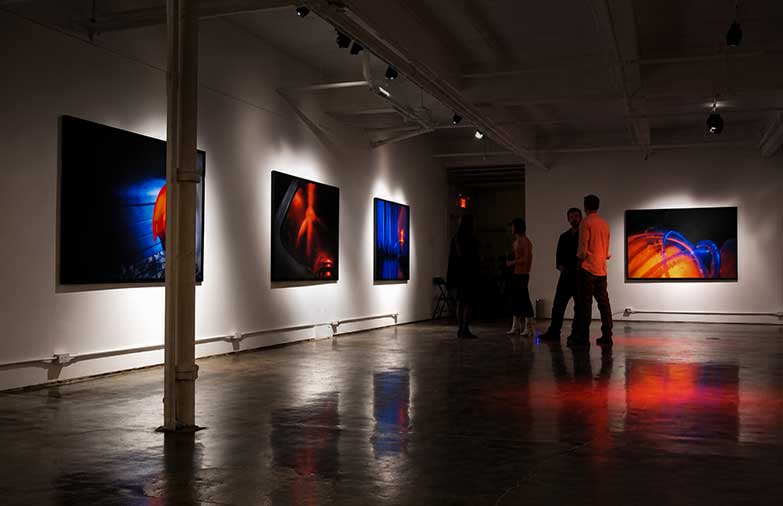
From Modern Homes, 2008
The Leona Drive Project gave me a chance to expand on these ideas. When the Yonge-Sheppard subway extension was being dug, it affected the water table and drainage patterns in the surrounding area, and many houses – bungalows built during or after World War II – were constantly flooded and had to be condemned due to mold infestations. I worked in several basements, where I found there was always the sound of plumbing or water dripping. So I took a hydrophone and put it in a washing machine, and above it placed an IV drip. Everything was then plugged into a guitar amplifier, which I put on reverb: as you walked down the driveway, all you could hear outside was a kind of boom, boom, like a heartbeat. When you go into the basement, you see this little drip, and I made the inside of the washing machine look like trachea, because mold becomes toxic in the lungs. People said it was like actually walking into a photograph, and that this approach made the images accessible in a whole new way.
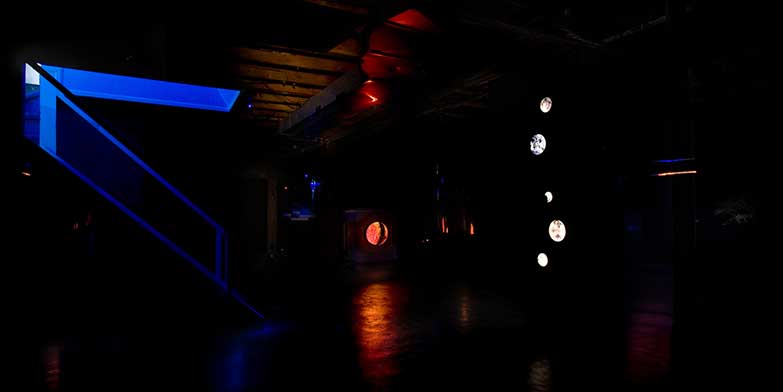
From The Leona Drive Project, 2009
Later, when I got interested in seed archiving, I had a chance to participate in Nuit Blanche in Toronto with The Vault, which was installed in the City Hall underground parking garage as part of a project called “Museum for the End of the World.” I was doing research on the Svalbard Global Seed Vault and was fascinated by the idea of a place built to protect life by freezing it. This connected to ideas I was already circling around: collections, specimens, preservation, containment, memory and anxiety about the future. It was also a project through which I started to understand preservation not only as a scientific process, but as something beyond science: the seed is small, dormant, almost invisible, but it holds the possibility of future growth.
I placed backlit transparencies — macro and micro images of frozen seeds and suspended, floating roots – into large tubes lined with reflective mylar, and I also created a sound environment. Since this was a public event, it attracted many people who might not otherwise go to a gallery. Towards the end of the night, some people were getting intoxicated and actually crawling into some of the tubes… at first I was mad about it, but then I also realized that they were fully immersing themselves in these photographic structures, which I thought was really interesting. The space of an artwork is made active by the people who enter into it, who invest in it, even if it’s in a crude manner.
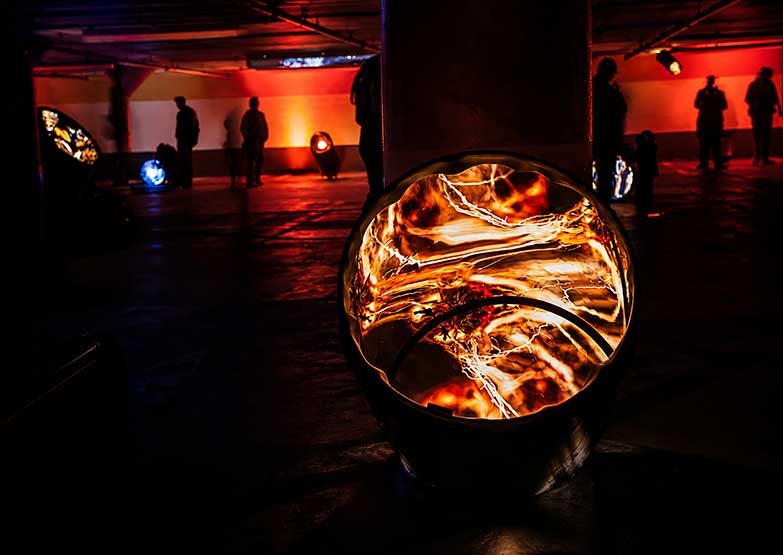
From The Vault, 2012
In 2016, unusually warm temperatures and heavy rainfall caused meltwater to flood into the entrance tunnel of the Svalbard vault. The seeds were not damaged, but the incident exposed a contradiction: a frozen archive designed to protect life from future environmental instability was itself vulnerable to environmental change. Thaw/beta grew out of this tension between preservation and vulnerability, protection and failure, suspension and thaw. Completed a few years after The Vault, the project explores the idea that a seed is only activated by what we are going to do to it in the future, and the ways this idea runs parallel to the notion that artworks are only activated by the people who interact with them. There is always a potential in an exhibition space, but it is only realized by how we navigate it – and if this idea works for a PhD student, and it works for a four-year-old, then I’m happy.
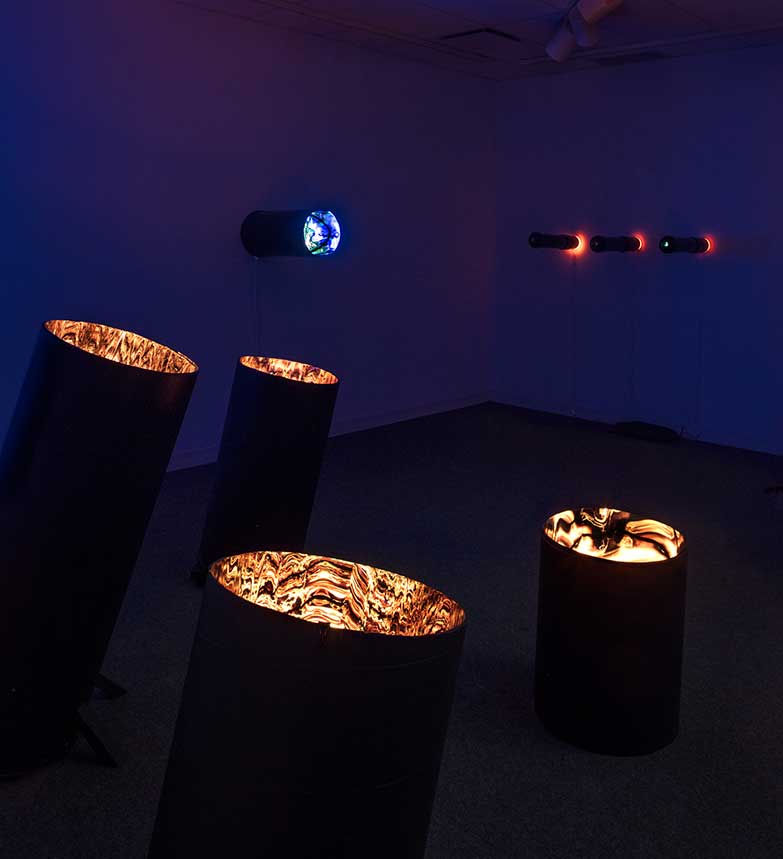
From Thaw/beta, 2017
My practice has taught me that photography is not only about recording what is in front of the camera, but also about working through ideas, That is also how I teach: I want students to see technical skills as tools that can help them build visual narratives, think critically about culture and context, and create work that can be experienced visually, physically and emotionally.
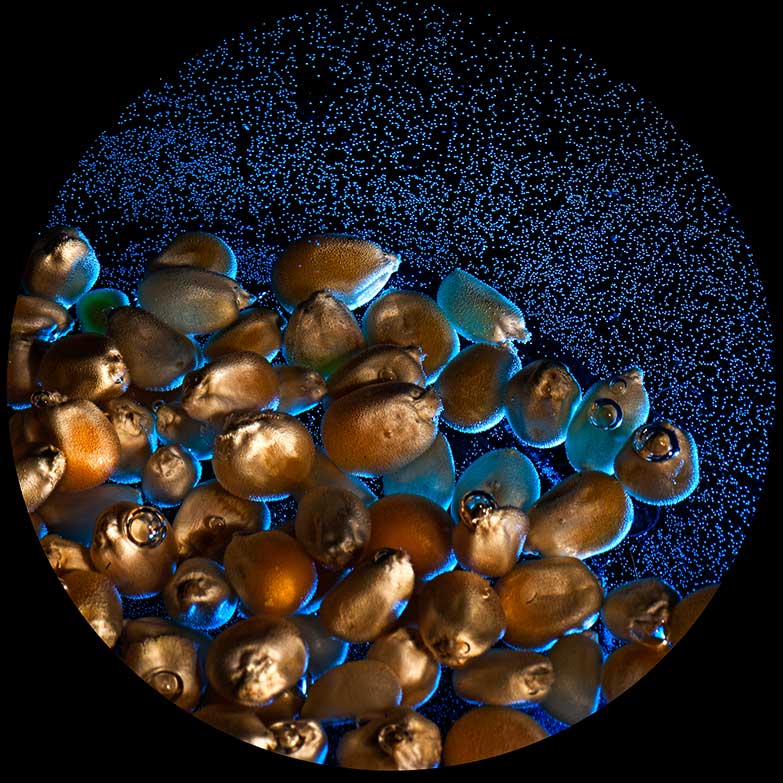
From The Vault, 2012
Going back to Ladakh this summer, I’ll be traveling north from New Delhi and returning to Hemis Shukpachan, the village connected to my earlier work; I’ll also be visiting places such as Leh and Likir, which are a bit easier to spot on a map. But this time I will be seeing things through the larger concerns that have developed across my practice: preservation, ecological memory, migration, agriculture, and the relationship between people, plants and place—how fragile systems of life are preserved, transformed, or lost over time.
In one sense, it’s closing the circle; but in another, it’s a different journey altogether.
Video panorama from Demul Khas, India, July 11, 2026
Returning from India in August, Blanchard wrote about his experiences as follows:
I was in India for seven weeks, retracing some of my steps from the 1999 journey. I travelled overland from New Delhi, north through the Spiti Valley and into Ladakh, eventually setting out to find the family I had stayed with in Hemis Shukpachan and to present them with two copies of photo books I had made from my time there many years ago.
Along the way, I encountered significant changes to the environment, technology, forms of communication, family dynamics and infrastructure. The Spiti Valley, a high-altitude Tibetan Buddhist region in Himachal Pradesh, seemed closer to what I remembered of Ladakh; however, Spiti is now facing many of the same challenges that Ladakh has experienced, including water scarcity, cultural shifts and the effects of increased tourism.
Working with a member of the Women’s Alliance of Ladakh, I was able to locate the Chuli Chan family. Rizzin Tsewang, the father, had moved from Hemis Shukpachan to Leh, as had most of the family, although they now lived in separate homes; several family members had passed away. Only two of the sons now live at the family home in the village, and only part-time.
It was incredibly moving to see the Chuli Chan family again after 26 years. Watching the family interact with the photographs, recognize people and revisit those memories made me realize that these images had taken on a life beyond my own experience of making them. In a sense, the photographs were being activated again, through memory, conversation and the sharing of history.
I found that farming and harvesting practices had undergone many changes. While I still encountered people using traditional methods, hired migrant labour had increasingly replaced family and community harvesting, and machinery was now being used for some of the work traditionally done with animals.
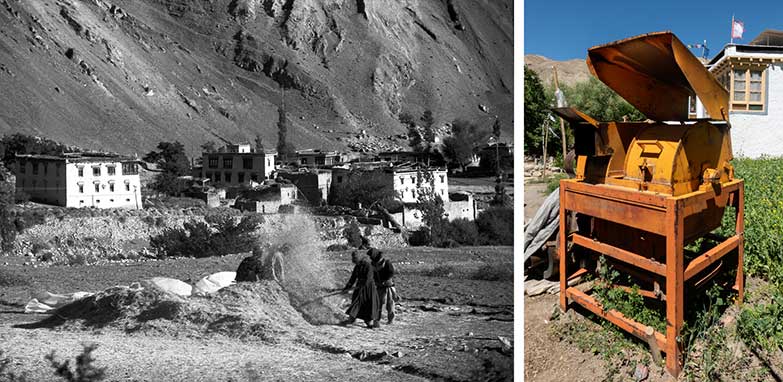
Threshing, Ladakh, 1999 and 2026
I was also interested in how families preserved their own seeds. In Spiti, many traditional homes had storage rooms hidden beneath their living room floors where barley seeds were kept for sowing the following year. While similar practices may still exist in Ladakh, I did not encounter them during this visit.
In both regions, I saw communities adapting to changing weather patterns alongside the economic and cultural changes brought about by tourism. These adaptations included artificial glaciers, man-made reservoirs and water diversion channels designed to capture, store and redirect increasingly limited water resources for agriculture. Seeing these systems firsthand brought many of the questions I had explored through The Vault and Thaw/beta back into everyday life: how we preserve what we have, what is passed from one generation to another, and what happens when environmental and economic pressures make traditional systems increasingly difficult to maintain.
The return affected me in ways that extended beyond my artistic practice: the photographs I made years ago helped shape the way I think about memory, community, preservation and our relationship to place, but they also became more than simply a record of that journey. They became a way of communicating across time, and ultimately a catalyst for my return.
Although I encountered enormous changes, what felt remarkably familiar was the kindness, warmth and compassion I experienced from the people I met and reconnected with. Rooted in the principles of Tibetan Buddhism and a strong sense of family and community, these were qualities I vividly remembered from my earlier journey. To experience them again gave me a sense of hope for the increasingly unstable times in which we live.
Thomas Blanchard’s work can be viewed at https://www.tblanchardphoto.com/
More images from Ladakh are available at: https://www.tblanchardphoto.com/ladakh-1999
Video footage from The Vault: https://youtu.be/g7cQV0StWps?si=AbGU0Bqj0Vle8j2s
Video footage from Thaw/beta: https://youtu.be/FfcdvaPb5HI?si=brSicpce9-6x_tnf
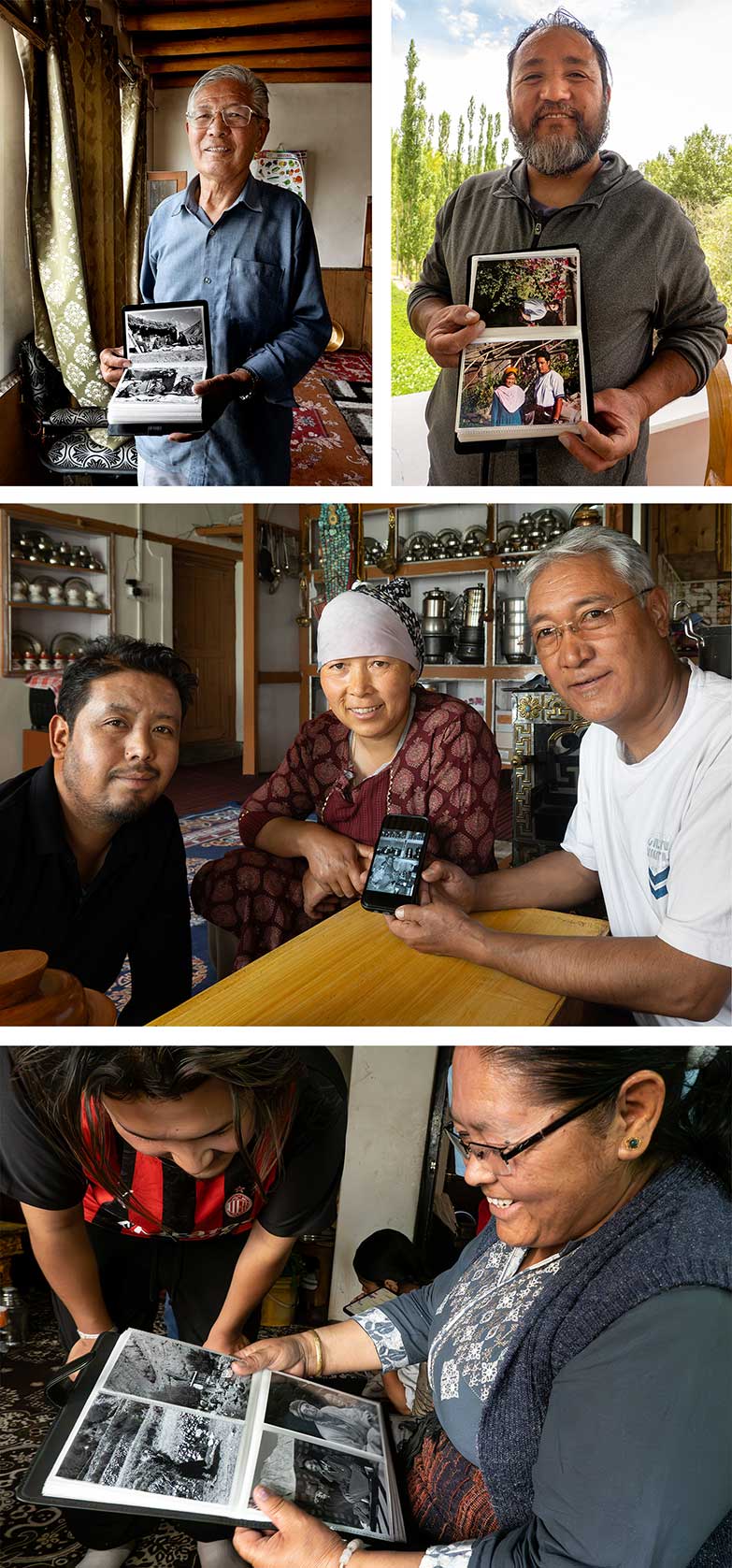
Chuli Chan family, 1999 and 2026
All images copyright 1999-2026 by Thomas Blanchard