
Around the Way: A Conversation with Wayne Salmon
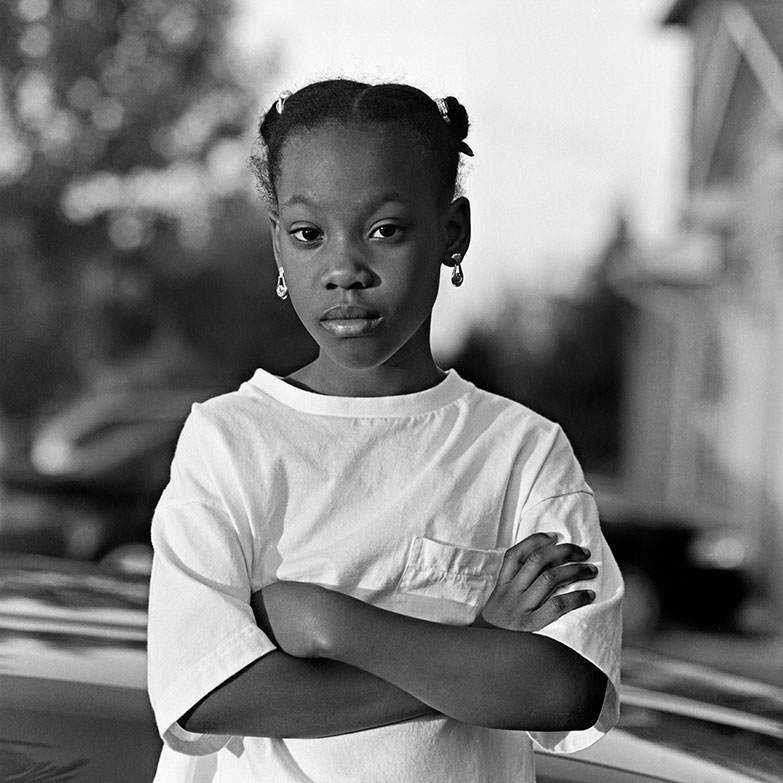
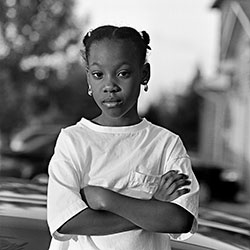
Shonny, Scarborough, 1995
Toronto-based artist Wayne Salmon works in photography, film and installation. Born in Jamaica, he immigrated to Canada in the early 1980s. His work is concerned with issues of community, culture, family, memory and the effects of migration and displacement. He learned photography early, and started his professional career while working at one-hour photo labs, and later at Kodak Canada. Salmon earned an MFA in Documentary Media at Toronto Metropolitan University, was the founding editor of Umoja Urban Culture Magazine, and is also a co-founder and curator at Brickhouse Studio & Gallery. He teaches courses on photography and historical processes in The Faculty of Media, Creative Arts, and Design at Humber College. Salmon’s writings have appeared in The Great Black North: Contemporary African Canadian Poetry and in The Unpublished City, Volume II. His photographs have been exhibited in galleries and museums in Canada, China and the US, most recently at Gallery 1818 in Toronto during the 2026 CONTACT Photo Festival. He is also the director of Shut Out, Locked In and Freedom–films that reflect on black life in Canada.
When I came to Canada I didn’t know how to play any sports, so when there was a trial for the basketball team, I went to the library and got some books on basketball, some how-to books, and it worked out pretty well for me, because I ended up making the team.
Later, in grade 6, we were going on a field trip, and my teacher, Mr. Miwa, was going to give us cameras. I didn’t know how to take photographs, so I went to the library and again got some how-to books, this time on photography. I would take the camera that we had, one of those 110 cameras, the long ones, and I would practice with the camera, even though there was no film in it. But my brother sees me doing this, and he takes the camera away and tells me to go outside and make some friends.
Instead, I got a cereal box, cut out a piece of cardboard and put a hole in it, and started using that as a viewfinder to compose — you know, to move the body around and shift perspectives. But my brother sees this, he takes it away from me, and he puts me outside and locks the door, because there were some kids playing down the street. And he goes, I’m not going to let you in until you go play with the kids down the street.
Somewhere Downtown, A Long Time Ago
But eventually we did go on the school trip. I employed the techniques that I had read about in the books, and my teacher liked the images. And what was interesting was we were supposed to write poems to go with the images, and I did a few poems that went with some of the images. And he had me take them to the principal to see. And then I went home, and I told my mom about it, because he told me to go tell your mom. But my mom didn’t make a big deal about it, though. She says, oh, this is wonderful. And I thought that was the end of it. But then… looking back, what she did was she went out and got a 35mm camera. Not a top-of-the-line one, but a much better one than we had before. And then whenever there was a chance to take photographs, she would say, let Wayne do it. Let Wayne take the pictures. I became designated as a family photographer based on that experience.
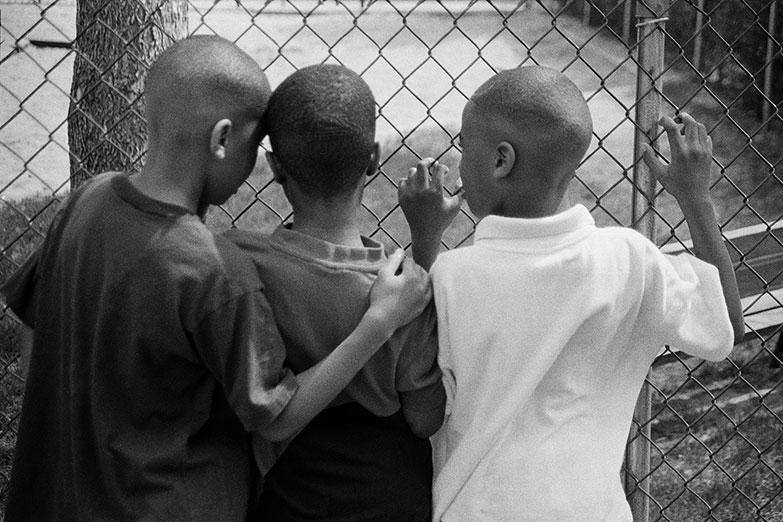
Cousins, Oshawa, 1990
Later, I took a course. I went to C.W. Jefferys to take painting, and I was involved in painting courses, but on the way to class between our lockers and class, there was a photography department. We were young, so we would say things to aggravate the teacher and the other students. We’d say things like, oh my god, is there really a teacher involved in this process? Like, why do these images look so terrible? And then we’d run off. But the teacher, one day he waited for us around the corner in a little bit of a hallway or alcove. And I did my little spiel about how terrible the work was, and then when I went to run by, he steps out.
And he gave us this lecture, oh, you guys are always saying things, why don’t you take the course if you think you’re so… why don’t you take the course? So then, a friend and I decided that we were going to make a bunch of photographs, photocopy them, and plaster them in the hallway. And my friend comes up with this idea that I should photograph all the women in the school. But he would be in the picture with them.
Another friend who was also taking the course, a guy named Charlie, ended up selling us a camera, and we went halves on the camera. We started going through the hallways, taking pictures of my friend with all these women, saying, we’re taking pictures of the most beautiful women in the school, would you like to be a part of it? And of course they said yes. We took a whole roll of images… and by the end of the first roll that we did, my friend ended up getting a girlfriend.
And so he was out of the process, he just, like… you know, stepped out of it. And then, because we weren’t taking pictures or anything, I went to him and I said, I want my half of the money for the camera. And he goes, oh, sure, okay; in the meantime, hold on to this — and he hands me the camera.
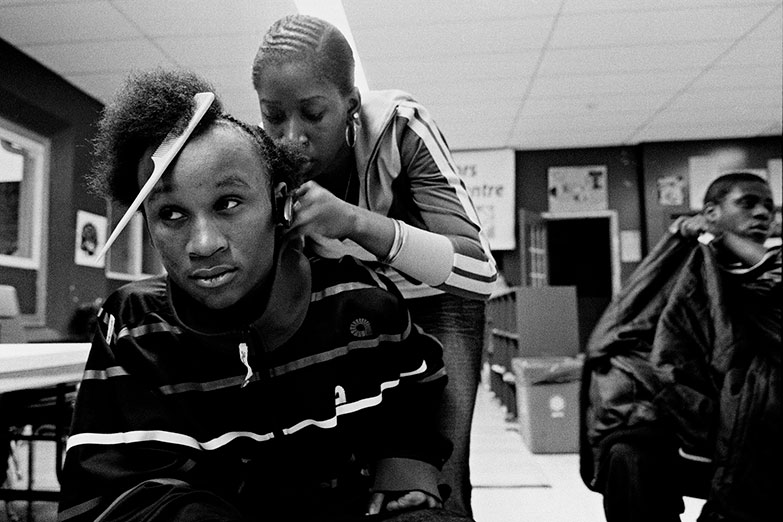
Braid-Up, Regent Park, 1994
I had a roll of film, but I didn’t know how to load it, so I had to go back to this same teacher… and I ended up taking his course. And through the course, he recommended me for a job at the local Kodak One Hour Photo Lab.
Everyone thought I was a professional photographer because I was working there. Even though I told them, listen, I’m not a professional, they insisted that I photograph their weddings… I said, listen, I’m not a photographer. “I’ll give you $200.” No, listen, I don’t know… I’ve never done this before. “Okay, I’ll give you $300.” So I ended up photographing weddings, very small weddings, but I didn’t bother charging people, because I knew people didn’t really have the money for a photographer. That’s why they were asking me, while I was working at the lab.
But of course, these things travel. And I ended up taking pictures of, like, maybe a birthday party here or there. One guy had me take some photographs of Public Enemy. He was involved in a music group, and Public Enemy was coming, so he got me tickets to go, and I took pictures of that and gave him the negatives.
That job… it taught me a lot. I remember, I was just thinking about what I had learned in the photo class, that there are different negative sizes and different camera qualities, with better optics that give you better images. We learned about Leicas and Hasselblads, and those were, like, the Rolls-Royces and the Corvettes of photography. But when I was working at the Jane and Finch Mall, the people were bringing in really poor-quality cameras and the images were hardly holding together. They were often fuzzy, the quality of the color wasn’t as vivid, and I thought it was a bit of a rip-off.
One guy came in and he wanted enlargements, and I said, are you sure? When you blow it up, it’s going to fade, the color’s going to be green, it’s going to be soft. He goes, yeah, yeah, yeah, I just want it blown up to, like, 16 by 20, or whatever size. When the image came back and it was blown up, I was trying to educate him, saying, you see, you need a better lens, a better camera, a larger-size film, because this is what happens. After I finished my lecture, he looks at me and he says: Can you see that that’s me? And I said, yes. And then he goes to me, so what’s your problem?
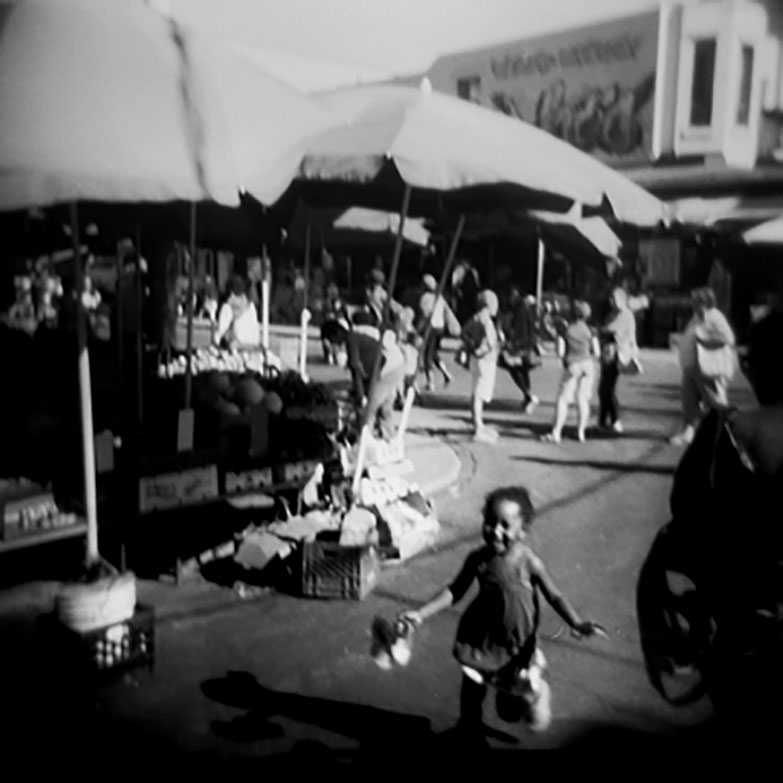
Ione Running Through, Kensington Market, 2010
In that instant, I think I realized that aesthetics are not something that’s supposed to be universal. For this individual, recognition was the principal thing. After that, I stopped telling people what to do with their pictures.
And I think this idea carried over with me, because when I started photographing the Kensington Market, I wasn’t so much interested in image quality, or sharpness, or the technical aspects that go with photography.
And another thing that made me think of him: when I was in Africa for an extended time, I brought a Hasselblad with me, but there was a compromise: either you buy more film, or you buy a proper light meter. Someone loaned me a light meter that was pretty old, and on the second day of that trip, the light meter broke, so I had to rely on my memory from the previous days of what the light was and what my settings were.
I went through 3 months of making photographs without a light meter, just by trying to remember how the light was when I did have a light meter. And my thought was that as long as it was close enough, I wasn’t so much concerned about mechanical accuracy as I was about getting an image.
So, in a way, that freed you up to just really relate to people?
Absolutely, because based on that experience when I came back to Toronto and I did buy a light meter, I still got in the habit of watching the light and making my adjustments before I met people. For instance, one of the first things I photographed when I came back was Caribana, and I wouldn’t just go up to somebody and meter them, I would already know what the light is doing and have my camera with everything adjusted. So when I met up with someone, the encounter became central before making the image.
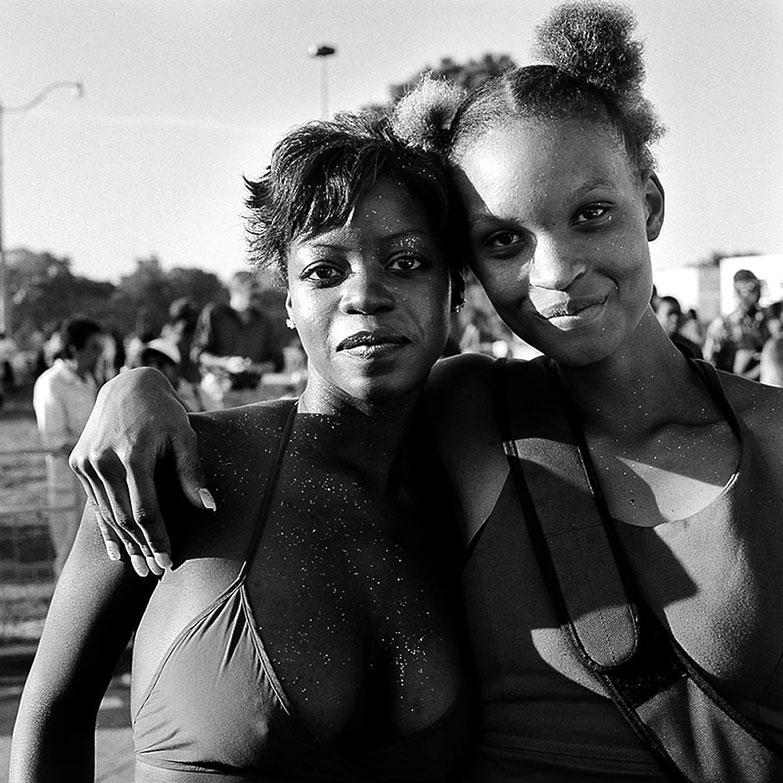
Two Friends, Caribana, 2000
Prior to that, I had photographed Carnival for 2 years, and I used a 35mm camera, but the images for me weren’t working. This is before I went to Africa. And I think a part of it, too, was when I really stopped and looked around, I saw photographers who were running up to other people with the camera already at their eye, telling people to move, having people pose, you know, just rearranging people.
They were kind of interfering with people. And I think, too, I began to see the 35mm as a sort of gremlin fed after midnight. It just wants everything, it wants it now, it wants it immediately, it wants it quickly, and I think people then become desensitized to having their photographs taken.
But when I was in Africa, working with the two and a quarter in different communities, people kept telling me to slow down. There’s a word in Swahili, it’s pole, pole, slowly, slowly. And so… after a while, I got to understand that communities have certain rhythms that they move in.
What they were saying to me really was, you’re out of sync with us. You need to be in relation, you need to be in sync with the community. Like, there’s a temple here. I don’t know if I’m explaining it correctly, but I think pole, pole is a kind of way of saying, be with us. And being with us means being in sync with us.
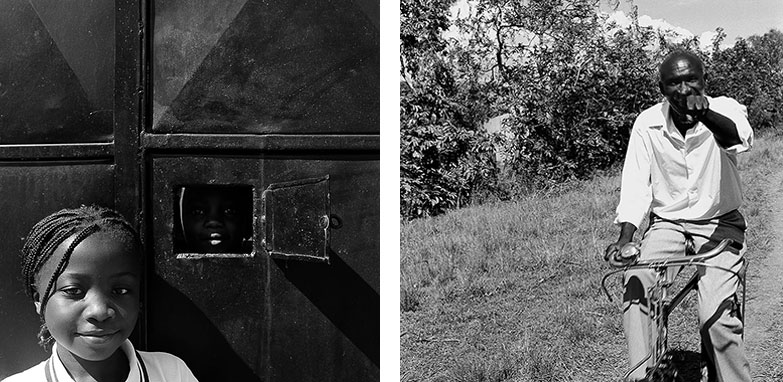
Pros and Lavesh, East Africa, 2000
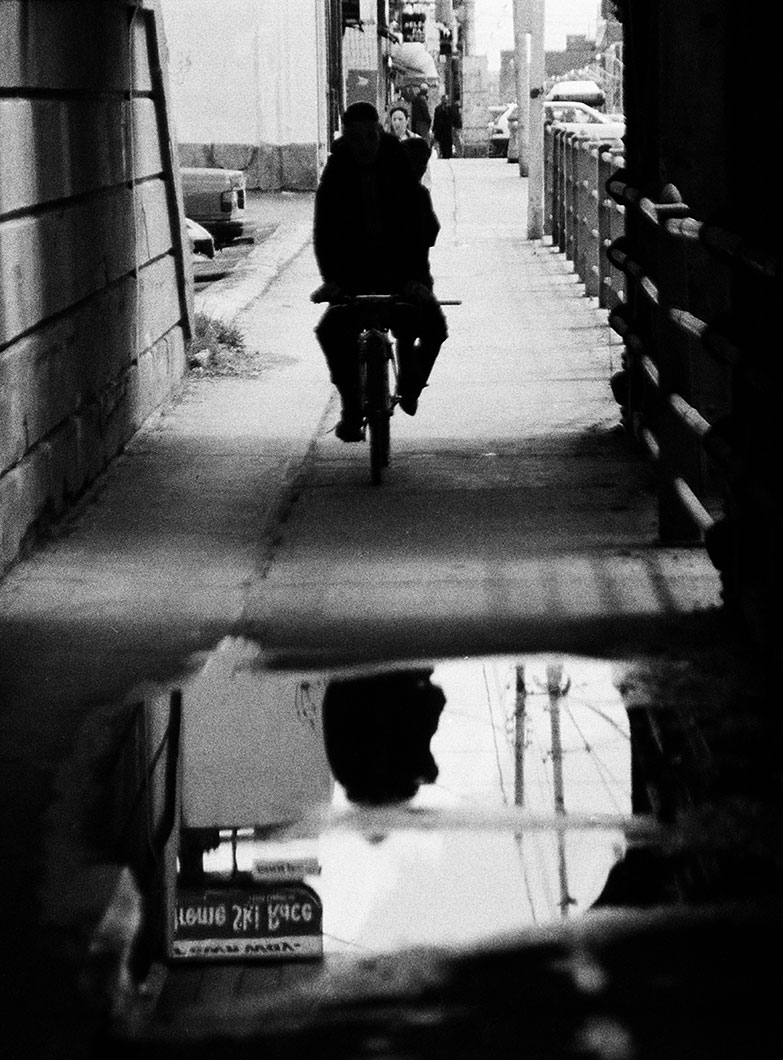
Man on Bicycle, East Africa, 2000
And I remember, too, when I was in Trinidad, with Carnival, the sister of a woman who I stayed with — I was out photographing, and she was there, and I was just walking, and I wasn’t paying attention to how I was walking, and she comes up to me and nudges me, and she says, Wayne, if you keep moving like that, you’re going to be exhausted by the end of the day. This is how you move. And she starts… she calls it chipping.
She says, you have to chip. And what chipping is, is you kind of lean forward, and as your body is moving down, you chip your foot forward. It becomes a kind of semi-dance. So you’re not using all your energy to lift up your foot and place it the way you normally do. It’s almost like a forward-moonwalk kind of thing. And there’s even a song… I don’t know the name of the song, but there’s a thing that goes, chipping, chipping, chipping down the road. And so that, for me, was another idea about being in sync.
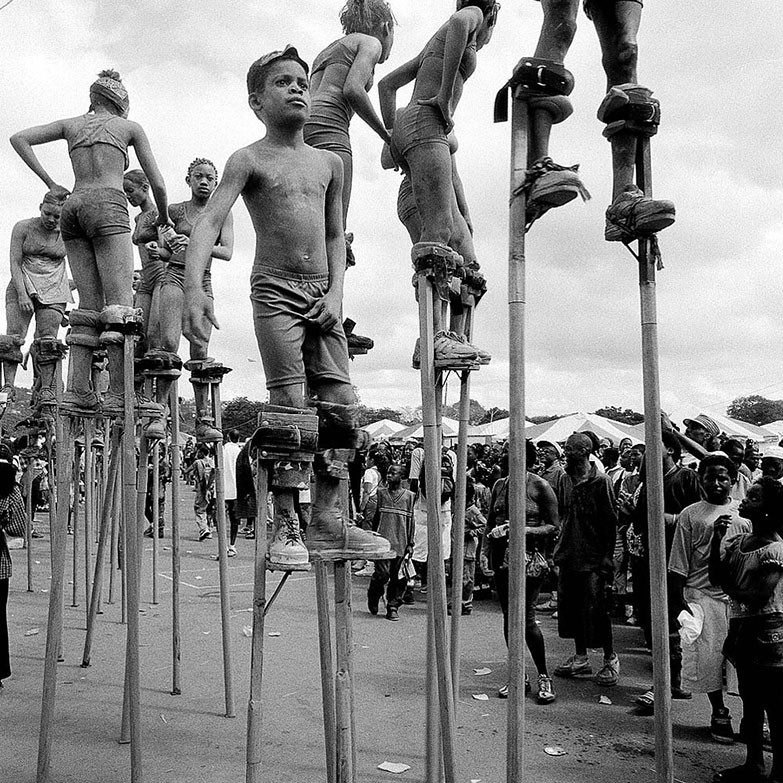
Unsteady, Carnival, Trinidad, 2001
And I think for Carnival, or Caribana, the music is tuning hundreds of bodies simultaneously, and once you’re in rhythm with that tune, you’re in rhythm with everyone else. And of course, it’s part of thinking about community and being in relation to other bodies.
It even goes back to my childhood… I grew up with my grandmother and my great-grandmother. Now, my grandmother would have me go every morning, to buy half a loaf of bread. Which made me angry, because I thought, why couldn’t you just buy a whole loaf and save me the trip the next morning? However, part of my task was I had to stop off at these different houses and ask the women there — they were older women — and I asked them if they wanted bread. They never wanted bread. For years, or months, I was asking these women, and never, ever, did they want bread. But I had to report back when I got to my grandmother, and of course, I didn’t want to get in trouble.
So I would go and I would check in on them, and they were always very nice, very pleasant women, but they never wanted any bread, which I knew. It wasn’t until years later I realized that I was doing home checks. I was really checking in on them. That’s why I had to report back to my grandma, because as soon as I got back, she was never interested in whether or not they wanted bread. She wanted to know who didn’t answer. Did so and so answer? Did so-and-so… okay, fine. And that was the end of it.
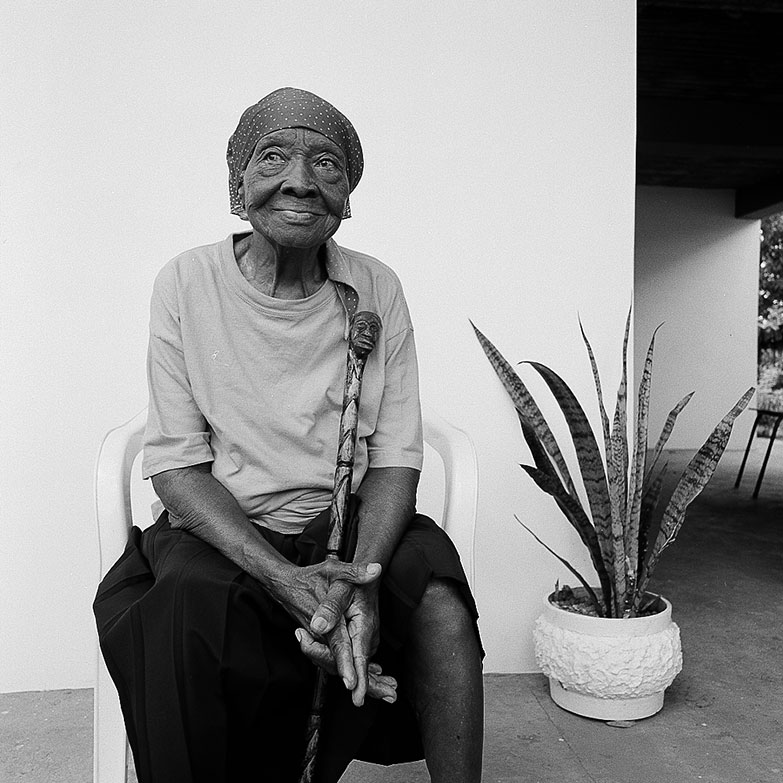
Great-grandmother, Trinidad, 2001
Already, this notion of community and responsibility to the community was right there. And another thing I did, was some of her friends and some of the older women, they didn’t read, and they didn’t write. So, my grandmother would take me around to different homes, where I would read letters from people who had gone abroad. I would read the letters and then I would write down the responses. And, of course, I wasn’t allowed to mention any of this to anyone. My grandmother said, this is just between you and them, you don’t discuss this with anyone else.
There were also instances where my grandmother would cook, and my great-grandma did this a lot, too, and they would give you a parcel of food to deliver to somebody’s house. But of course, you weren’t allowed to talk about this. It was understood that this is not something you discuss. This is something you do, and that’s the end of it, and you forget about it.
In that sense, I guess community was very much a part of how I was, conscious, yet unconscious; this whole thing of reciprocity, of being connected to other people. And in Jamaica, there’s a saying that goes, today is for me, and tomorrow is for you. So there’s this whole thing of community operating in a way that there’s balance over time: you know, people take care of each other.
There’s another aspect to that as well, in respect to community, because I grew up with a certain kind of reverence for the Rastas, and how they practice community.Not only did they practice community, but they wanted to redefine for themselves what that community was supposed to be like, not only in terms of how they dressed, how they wore their hair, the language they spoke, the kind of jobs that they took, or the kind of things that they ate. They were kind of rebels, in a way. And they kind of set their own terms, their own frame of seeing, being seen, or being understood, even to the point where they kind of, rearrange the language to reflect the way they saw the world.
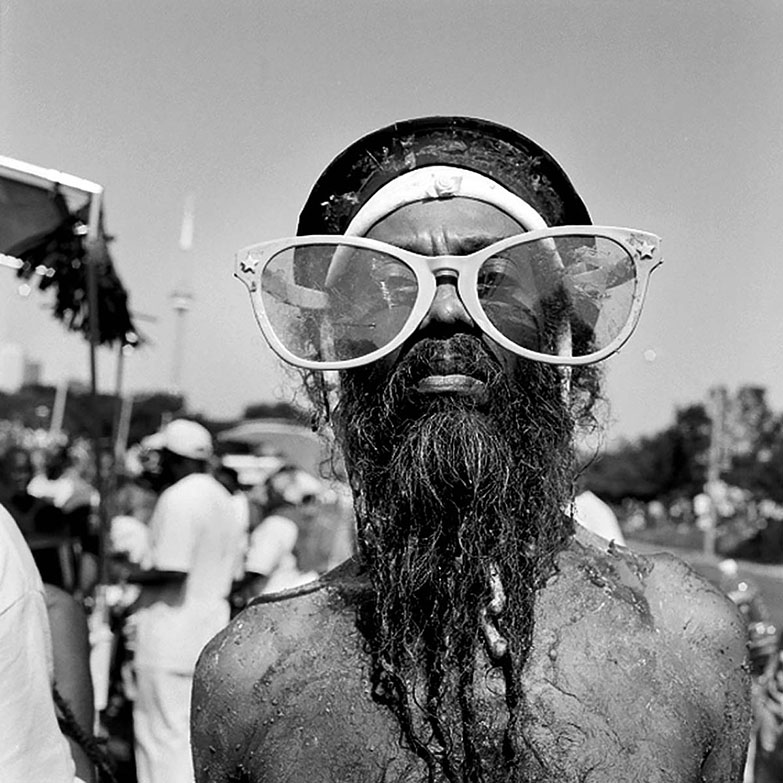
Glasses, Caribana, 2006
And I always thought that that was interesting, community operating on its own terms. My mother didn’t say much, but when she spoke, it kind of stayed with you; you’d remember something she said, and then it would get a certain kind of clarity.
A few years after we came to Canada, we moved to Gladstone Avenue, and there were only a few black people there. And I remember whenever we went anywhere, we had to go to the bus stop. And to go to the bus stop, you had to walk a long stretch of Gladstone. And there’d be people sitting on their porches, on their balconies, like, just looking out at the street. But I always felt self-conscious. And one day I said to her, you know, I don’t like going down that way. Can’t we go this way? And she goes, no, the bus stop is that way. Why would you go that way? I say, I don’t like all these people sitting out on their balconies staring at us.
And she goes, well, what concern is that of yours? You’re not supposed to be paying attention to other people. You’re supposed to know where you’re going, and to pay attention to how you conduct yourself.
And I thought, okay, without really thinking anything more about it, it’s about people paying attention to their experiences, to their worldview, and articulating that in some way, regardless of the art form–like jazz, for example, or the blues, or hip-hop, reggae, dub. Especially reggae, those Rasta fans, they didn’t care what people thought about them, how they looked, how their hair was, what names they called them. They had a certain kind of philosophy, a way of life, and so they paid attention to that.
Over time, I began to think of photography as…what if a community begins to pay attention to its needs, its worldview, its, philosophy regarding visibility and time? How can it become attuned to that, and really begin to articulate that to itself?
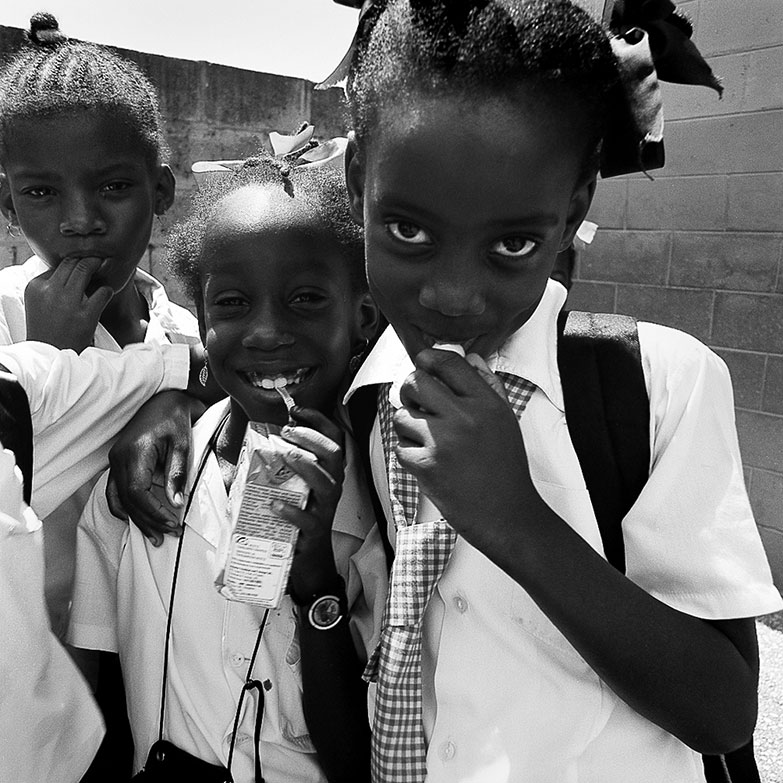
School Friends, Trinidad, 2001
I think it was Gabriel Garcia Marquez, in Love in the Time of Cholera, who wrote about a photographer who goes around photographing young children. He would photograph the children, and he would post the images on a fence. And people would come and look and recognize themselves and be very happy to see themselves represented in this way. And I remember when the photographer dies, they did an autopsy, and the scene was very beautiful, because when they cut open his heart, they found the chemicals had crystallized into diamonds. And I thought, wow, wouldn’t it be incredible to be that kind of photographer. But he wasn’t famous, he didn’t reinvent things. All he did was act as a mirror, reflecting a community back to itself.
So I think over time, I’ve come to look at photography as a way of tending to community. And then, of course, the whole language of photography becomes so very interesting.
The history of photography — beginning with pictorialism and their concerns, and then switching to direct photography, and then, all the things that come out of that — it’s operating within a certain philosophical structure, one that may not really be supportive of Black life. I think it was Hortense Spillers (author of Black, White, and in Color) who said maybe Black people should give up the visual field and focus on the sonic realm, because it’s only there that we have been able to tell our stories. Because we kind of broke into that world and rearranged it. We, bent notes, blurred them; echo, reverb, whatever needed to be done in that field, we did it, in a sense, and created new forms that spoke to our experiences in the diaspora.
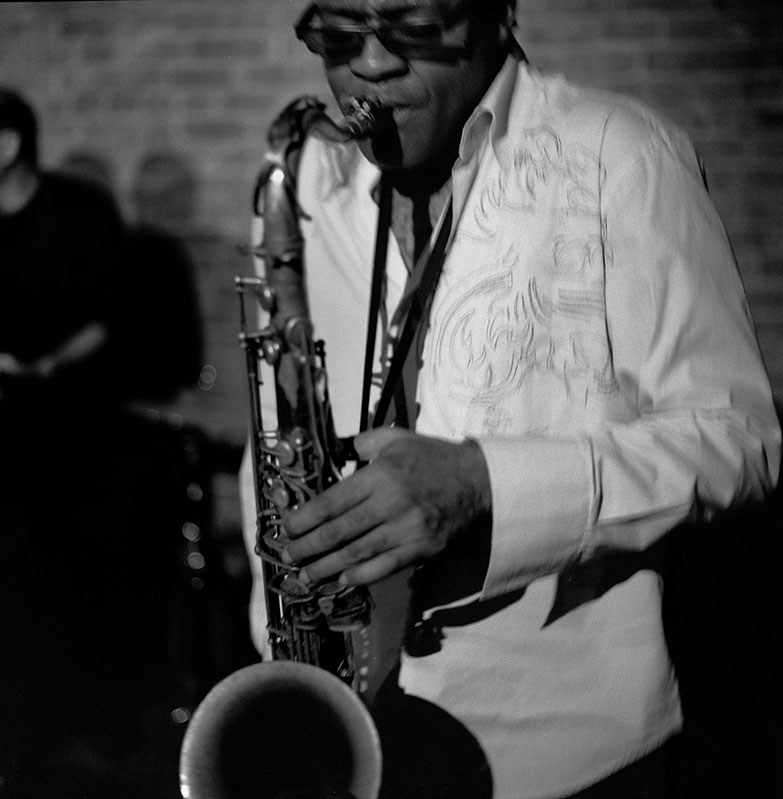
Saxophone Player, Trane Studio, 2005
But for some reason, in photography, it seems that we’re moving in a stream that has already taken a certain direction. I mean, why should we be responding to the white gaze, for example? Why should we be concerned with visibility or invisibility? Like my mother said, you should… you’re not supposed to be concerned about what other people are doing. You’re supposed to be focusing on what you’re doing, how you’re presenting yourself. Other people think what they want to think, but you know you.
There are certain things that should come before you click the shutter. It isn’t just about seeing… it’s not seeing with, it’s being with.
When we used to go shopping at Knob Hill Farms at Lansdowne and Dundas, we never took the bus, we had to walk. Once, when I was walking I was in, like, a sour mood. And as I’m walking, a car horn beeps, and then I look around, and there’s a guy in his car with a long telephoto lens. And he takes my picture. By the time I realized what’s happening, the picture was already made, and he was pulling the lens back into his car. So now my whole mood now shifts to this idea that there’s a picture of me, but it’s not me. It’s a picture of me out of sync with myself, and that picture is going to live somewhere, and it’s completely outside of my control.
I was in this moment where I wasn’t really prepared to be photographed, and somebody didn’t care, they just took the picture anyway. And when I was in Africa, I think I was in Zanzibar, and I was hanging out with these guys, and we were just, like, you know, talking, and then I saw a plane coming, and I’m thinking, like, what the heck? It was one of those small seaplanes. I’m watching everything, and the plane lands, and this guy comes out, dressed like he’s going on a safari with the safari hat, the jacket, the pants with all the pockets, and he’s being led by a guide, and he has that camera with that long lens. And I thought, oh, I know what that lens is about. That’s gear to sneak and take.
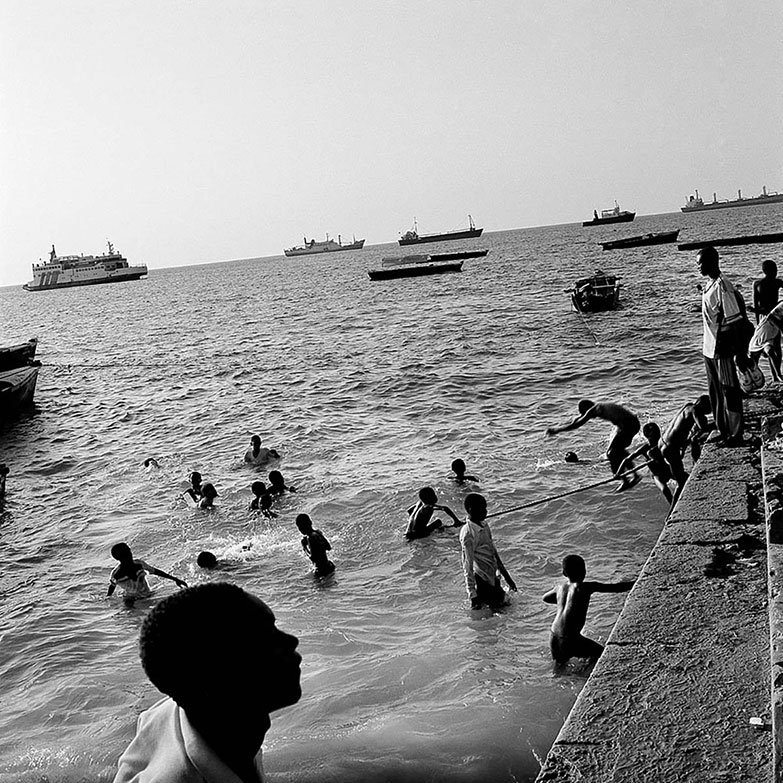
Harbour, Zanzibar, 1999
Maybe after that realization, I only shot with normal lenses, so if I’m taking your photograph, you know what I’m up to. The first thing we do is, we make eye contact. And… before I raise the camera to take your photograph, you see me seeing you. And then, I slowly raised the camera. And in that moment, in that encounter, you have the option of remaining with me, or looking away.
And I think… more times, people have remained with me, but I kind of think about staying with me in Carnival. Carnival becomes a kind of ritualistic space. It’s where you kind of let go of the me and embrace the we. You know that Muhammad Ali poem, Me, We? So, when you enter Carnival space, what’s considered the normal rules of engagement are abandoned, and different things can happen. And I think in Carnival, people are more open to that encounter than they would be, let’s say, at Yonge and Eglinton.
You run up to a guy at Yonge and Eglinton, and then you raise the camera — he may think, you know, what’s this guy doing? I’ve tried to take pictures of young people, when I was much younger, in the mall at Scarborough Town Center. And they were like, whoa, whoa, wait, wait, what are you, a cop? What are you doing? What’s that for? Are you the police? And I started laughing. I go, seriously? Do you think they’d hire me? And that was because I was in my 20s at the time, and they were probably teenagers. The question they posed to me, for me, was crazy; but the question itself wasn’t so crazy. People can become very guarded, because the camera is used to surveil, it’s used for spying, it’s used for taking.
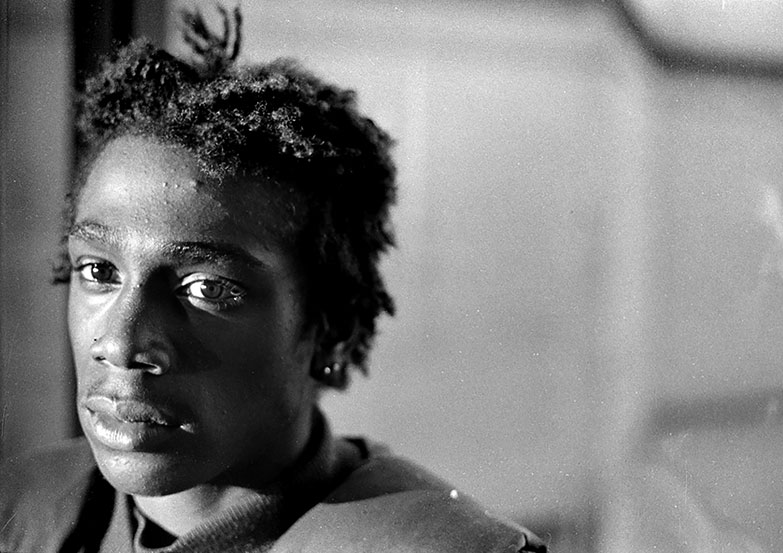
Young Man, Scarborough Town Centre, 1989
But in Carnival, it’s a community space. We are all in a space where we’re rehearsing, we’re practicing this togetherness. Music is there, it’s familiar, the food is there, the people are there, people are open to engagement. People are looking for old friends, so it’s a different… It’s a tuned space. It’s a different frequency, let’s say. That allows for different kinds of encounters, or for a more authentic version of yourself to emerge. Those stresses that you normally live under, maybe you kind of shed them for this day.
Historically, the way photography has been used exists within a philosophical structure that was already established before the medium was even invented. And if you don’t subscribe to those ideas, you have to ask yourself, what is photography for? For me, what is it for? If I don’t like what it’s been used for in relation to myself, how do I use it in relation to others in a way that is appropriate, or in sync with my way of thinking, or in the context of a community where certain philosophical systems are already in place — like caring, like rhythm, like time?
When you use the two and a quarter camera, and you have to advance the frame, and it’s only 12 frames, you’re not really quick with it. You have to be still, you have to wait, you have to identify, you have to make the connection with your subject… It requires a different way of meeting, a different way of using that time when the camera only allows you 12 frames.
And it always brings me back to that valuable information, all the things I learned from the older people around me growing up.
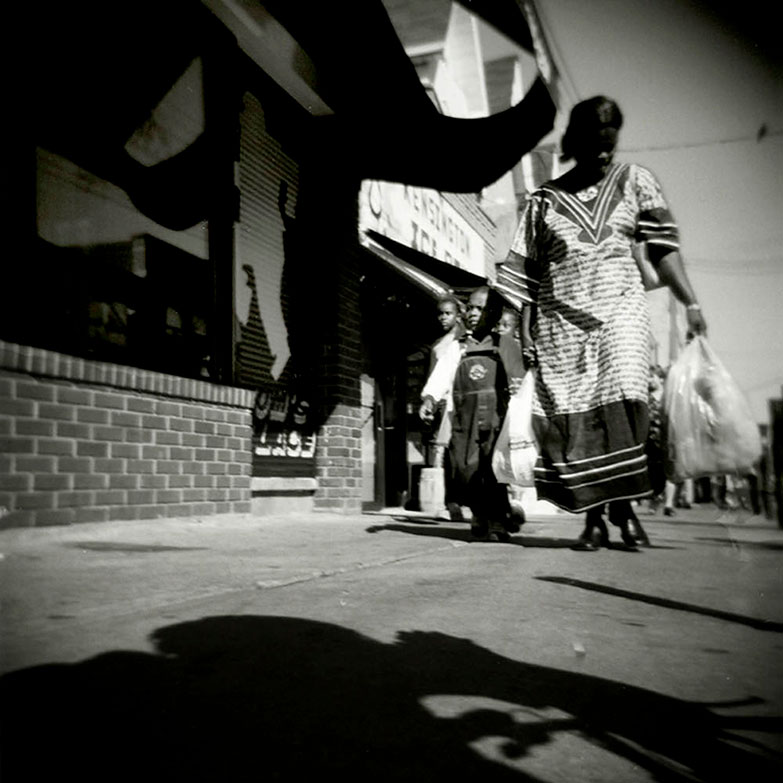
Woman with Children, Kensington Market, 2000
Wayne Salmon’s work can be viewed at https://www.waynesalmon.com/
And on Instagram at https://www.instagram.com/wksalmon/
A recent article on his work is available at Musée Magazine:
Play Mas: A Portrait of Carnival by Wayne Salmon | Gallery 1888 — Musée Magazine
All Photographs Copyright 2026 by Wayne Salmon