
The Saint John Trilogy and Other Stories: A Conversation with Chris Donovan, 2025
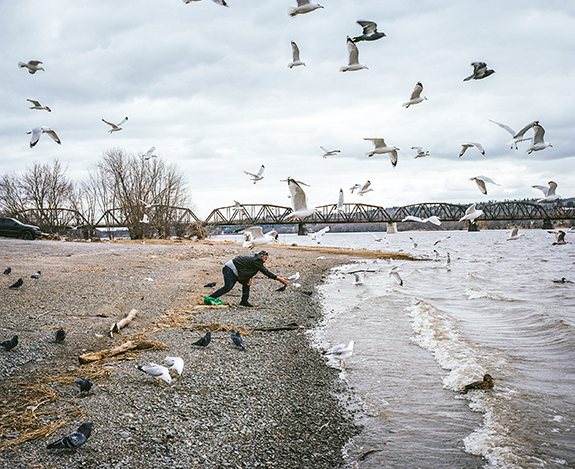
from A River With Three Names
Chris Donovan is a documentary photographer, video maker and educator based in Saint John, New Brunswick. He studied photography at Mount Allison University and Loyalist College and holds an MFA in Documentary Media from Toronto Metropolitan University, where he is currently completing a PhD in the Media & Design Education program. A member of The Boreal Collective, a group of Canadian documentary image-makers, his work is focused on long-form photographic projects which address issues of class, industrialization and environmental justice, primarily in Canada’s Maritime provinces and the American Midwest.
Donovan’s images have appeared in The Globe and Mail, Maclean’s, and The New York Times, as well as Huck Magazine. The recipient of awards including a World Press Photo Award and a Scotiabank New Generation Photography Award, Donovan is also the founding director of Photo E(a)st, a new photography festival based in New Brunswick. His most recent book, The Cloud Factory, was released in April of 2025.
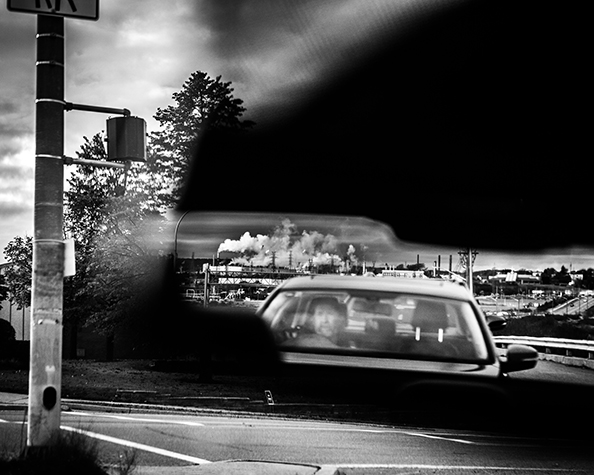
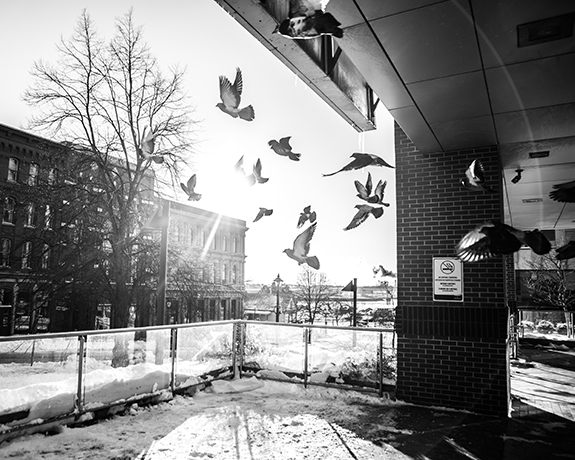
When we began talking earlier this year, one of his photographs had just been featured on the front page of The New York Times, introducing an article by Ian Austen headlined “Cloud Over a Family Empire.” Austen’s reporting on the Irving industries in New Brunswick was illustrated with six video clips and nearly two dozen photographs from The Cloud Factory, the first component of Donovan’s planned Saint John Trilogy.
from The Cloud Factory
“This is a case study in the failure of ‘trickle-down’ economics – it doesn’t work, it never has and it never will.” – from David, CT, in The New York Times, April 2025
The Times article generated three hundred and fifty-five comments, some of them furious. Others were reflective, defensive, or contrary-minded, and a few readers were altogether in denial. But nearly all responded with appreciation for Donovan’s work. When I mentioned this—it’s rare to find so many comments about photographs in an otherwise print-oriented publication—I learned that rather than just accept the praise, Donovan had instead been engaging in an experimental dialogue with Chat GPT about his images, asking it to progressively ramp up its criticism, even to the point where he reported that it actually started to hurt his feelings. Not many photographers would do that, but somehow it seemed natural for Donovan, for whom complacency is never an option.
My grandfather was a photographer, though I never met him. He was primarily a painter but made his living photographing weddings and doing some commercial work. He was Acadian, and from northern New Brunswick—George Dube was his name. (I have his artist signature tattooed on my chest.) I grew up surrounded by his paintings, both at home and at my grandmother’s. They were hung everywhere, in a sort of salon style… There wasn’t an inch of wall space. Somehow this gave me the sense that being an artist was something you could actually do.
As a kid, I was really interested in wildlife. We lived on the outskirts of Saint John, and there were always deer, birds, and groundhogs in the yard. I loved National Geographic and of course wanted to photograph animals. I remember playing football in the backyard when a woodpecker landed right next to us and started hammering away—I wished I could share that moment. So I saved up birthday money and bought a little digital point-and-shoot camera. Before that, I’d used my parents’ film camera, but the groundhog was always hard to see, because that camera had no zoom.
I was always an “art kid”—I did theater, too, and almost studied that instead of photography. I had a full scholarship for theater but chose to pay to study photography instead. It was close, and a hard decision.
I started at Mount Allison University but left after two years and transferred to Loyalist College in Belleville to study photojournalism. The program was a huge influence—Patty Gower and Frank O’Connor ran it. I got connected to Loyalist through a local newspaper intern who was a student there. He saw my “Humans of Saint John” Facebook project, which was inspired by Brandon Stanton’s “Humans of New York.” My project became popular quickly, and the local paper did a story on it.
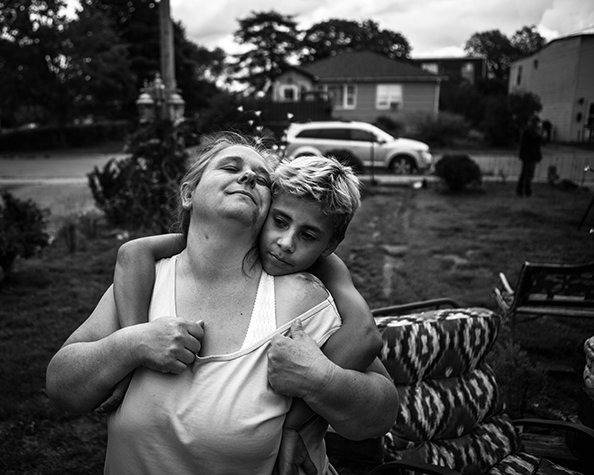
From early on, I was interested in Dorothea Lange. I found a book about the FSA at the Mount Allison library and kind of went down a Dorothea Lange rabbit hole. One of the New York Times comments said my photos looked like Dorothea Lange’s, as if that was a bias… I don’t think black and white is inherently biased, but maybe I’m too deep in the photo world to see how the general public perceives it.
from The Cloud Factory
Chris Killip, Eugene Richards, Gene Smith, and especially George Tice were big influences. Sebastião Salgado, too—his book “Genesis” was one of the first photo books I ever saw. It’s hard to find a documentary photographer not influenced in some capacity by Salgado or Robert Frank.
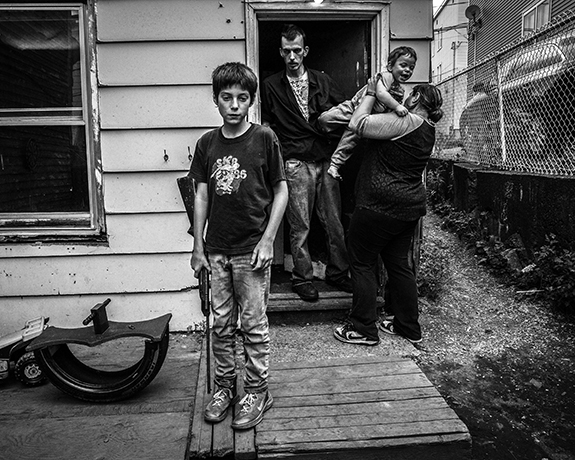
from The Cloud Factory
The project I’m doing now, as part of my PhD work, is called “A River with Three Names.” It’s the second part of a planned trilogy about Saint John; “The Cloud Factory” was the first. (The third project, about the punk music scene in Saint John, is called “Haven.”) This is about colonialism as an ongoing process, often referenced in the landscape. It’s not at all meant to be funny, but sometimes I work with a tongue-in-cheek approach.
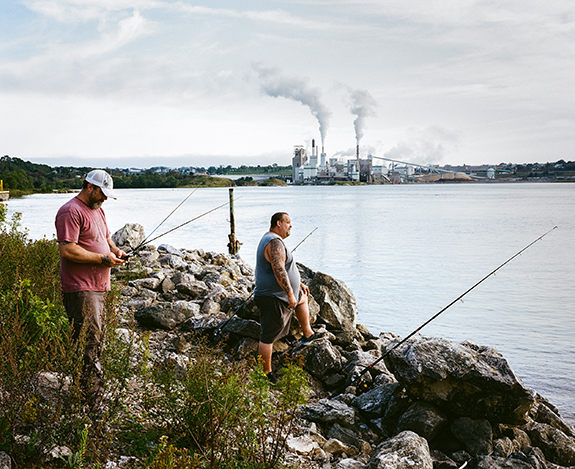
from A River with Three Names
I’ve always had a strong interest in art history. My parents were high school teachers and took students on educational tours to Europe, so I got to visit museums in Spain, France, and Italy. I loved wandering through galleries and looking at old paintings, and I still do. I took painting classes in art school but was never that good at it.
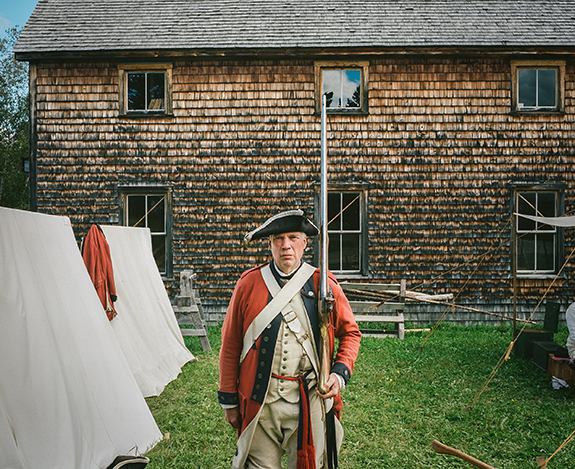
from A River with Three Names
I’m very connected to the lineage of documentary photography—some call my work “old school,” which is fair. I’m trying to keep alive the style I love, even as most documentary photographers move to color and digital. My new project is in medium format color film, but the third part of the trilogy returns to black and white, shot at night with flash, inspired by Japanese photographers like Daido Moriyama and Masahisa Fukase.
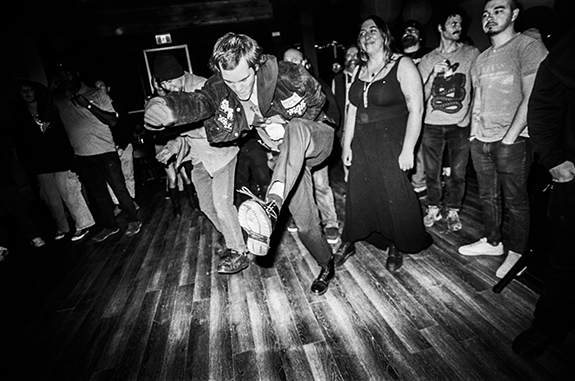
from Haven
I think now, if photos are in black and white, people assume you’re trying to say something or make things look bad. That’s not how I see it, but I’ve started to question it, especially after the reaction to the New York Times work.
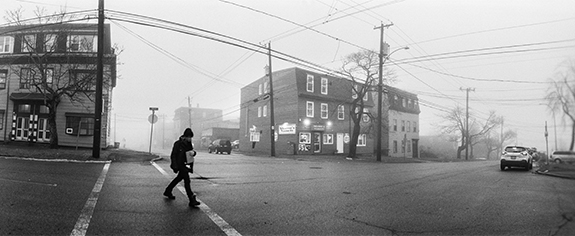
from Saint John Panoramic
At the core is a desire to observe and record what’s around me. I love art history, photo history, and see myself as part of a tradition. My PhD work is about landscape, colonialism, and the transformation of space into place. I’m interested in how photography can function as research, not just as art or journalism. I don’t think documentary photography alone is academic research, but writing about photography can be.
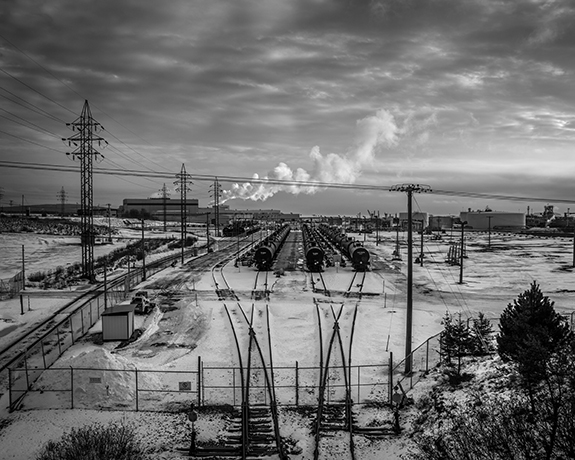
from The Cloud Factory
I’m also passionate about building community. I started the Photo E(a)st Festival to share contacts and resources and help build a community of photographers in the Maritimes. I have a strong belief in the saying that a rising tide raises all ships… I want people to come together and to talk about photography.
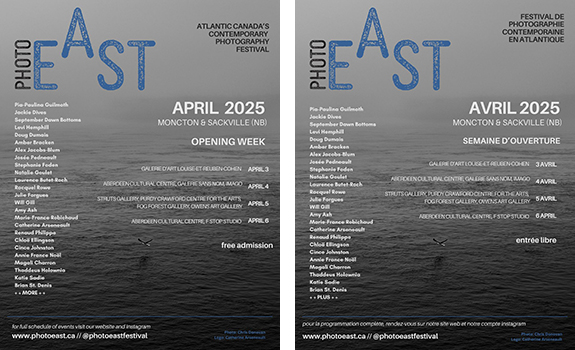
Cover Images, Photo E(a)st Catalogue
The Times piece seemed like an ideal confluence of creativity, information, and cultural reportage. Did it work the way you wanted?
“Ideal” is tricky, but it was as good as it could get for so-called legacy media. My work sometimes fits more comfortably in the art world, where nuance is valued, but the journalism world is headline-driven. The art world sometimes sees my work as too journalistic, but journalists can see it as too artistic. I like working in both worlds. The Times piece took years to come together, and it was rare to have a black and white photo on the front page. Internally, there was debate about whether the story was opinion or fact—some editors thought the black and white photos made it opinion.
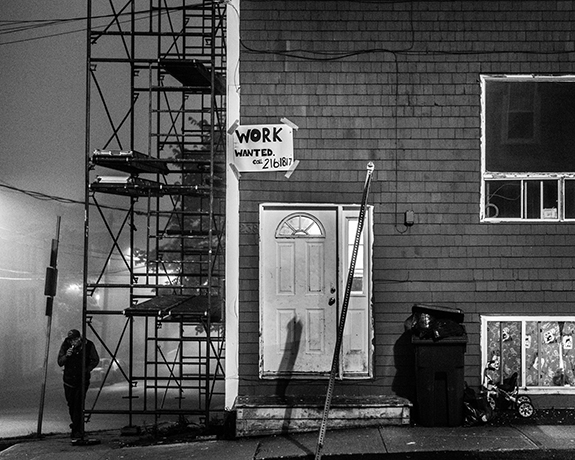
from The Cloud Factory
You’ve got another year in the PhD program. What’s your thesis going to be?
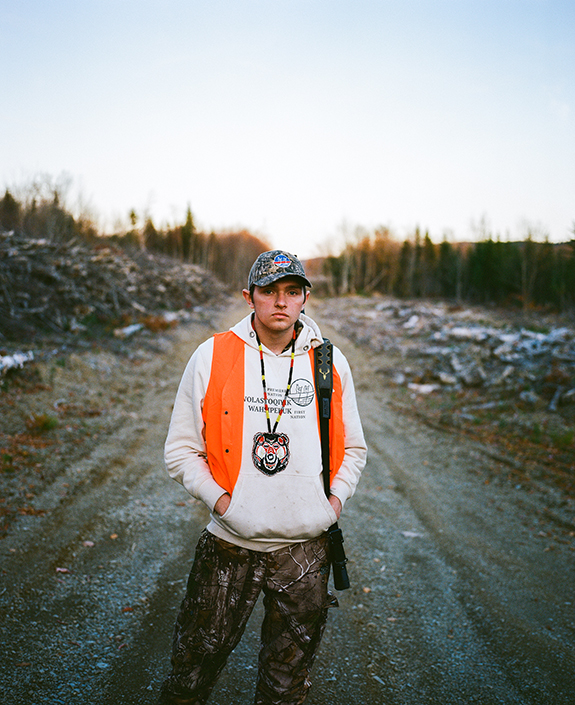
As I mentioned, my research focuses on “A River with Three Names,” a landscape project about the Saint John River and its history of colonization, especially by industry. Alain Denault, who was my co-author on “The Cloud Factory”, has written about New Brunswick being colonized three times: first by the French, then by the British, and now by the Irvings. A lot of the writing in my dissertation is about social landscape photography, and the role of photography in mapping and placemaking, particularly in relation to resource extraction. It’s described as a landscape project, but it includes portraits.
from A River with Three Names
I’m also working on a program called the Globe Photo Academy, a two-year, non-degree workshop for “Making Functional Art”, sort of like a low-residency MFA in its overall shape. I’m thinking about the idea of a Maritime center for documentary photography, and right now am converting the garage in our new home into a gallery space. The plan with Photo E(a)st, which launched this year with more than a dozen exhibitions and an accompanying catalog, is to produce the festival annually for three years, then make it biannual.
Are you planning to stay in the world of academia?
I’m not sure. I love learning and teaching, but my main goal is to support photography in the Maritimes and make my own projects. If academia helps with that, great, but I didn’t do a PhD just to become a professor—I did it to fund a project and because I love learning. I don’t see myself being chained to an institution, unless it’s one that I feel is really serving the idea of making work.
Part of having hands in so many areas—art, journalism, academia, curation—is survival. If you want to make a life as a photographer and don’t want to do commercial work, you have to cobble together funding from different sources. Assignments, grants, curation, and teaching all come together to help someone make a living.

from Clouds and Tankers
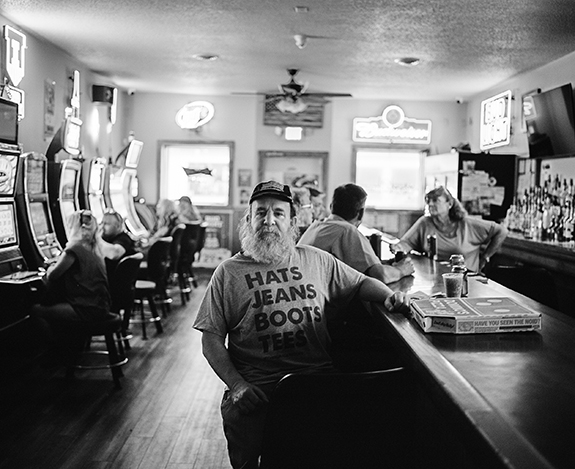
I think the conversation around work is often half the work itself. The work is a conduit for conversation, and if you’re not having the conversation, the work isn’t doing its job. It’s important to have people pushing these conversations and giving space for them.
from Paris and London
Chris Donovan’s projects can be viewed at: www.chrisdonovan.ca
The Cloud Factory is published by Gost Books:
https://gostbooks.com/products/the-cloud-factory
His recent article in The New York Times is at:
https://www.nytimes.com/2025/04/01/world/canada/irving-family-canada-oil-environment.html
Macleans published his work here:
https://macleans.ca/culture/irving-saint-john-industry/
Haven, his project on the punk music scene in Saint John, initially appeared in The Globe and Mail, as part of a year-long series on photojournalism:
https://www.theglobeandmail.com/arts/music/article-new-brunswick-saint-john-punk-scene-underexposed/
Work from the 2025 Photo E(a)st Festival is available at https://www.photoeast.ca/
and on Instagram at: https://www.instagram.com/photoeastfestival/?hl=en
from The Cloud Factory
All photographs copyright by Chris Donovan, 2025